Showing posts with label Commentary. Show all posts

Wednesday, December 11, 2013

Ironweed


The characters in Ironweed weren’t always without hope. Each of them once had the world at their feet, but let it slip away. Now it’s gone, and it is never coming back. Hector Babenco’s 1987 film of William Kennedy's novel is the story of a man awash in guilt, sadness and self-loathing, who travels back to the source of all his pain.

Francis Phelan (Jack Nicholson) first appears awakening from beneath a blanket of newspapers on a cold, blustery morning. Francis is a bum, and the film quickly assures us that he has been one for some time. Riding with his buddy Rudy (Tom Waits) to a job digging graves, we start to realize that Francis is back in his hometown of Albany for the first time in many years. It’s here in this cemetery that Phelan starts to shed a little light into his past. He walks past the graves of his parents, and stops at one belonging to his infant son Gerald. Gerald was only 13 days old when Francis accidently dropped him on the floor, killing him instantly. Unable to forgive himself, Francis left home and disappeared into a miasma of alcoholism and poverty.


 Phelan’s companion Helen Archer (Meryl Streep) has her own history. She was once a promising classically trained singer and pianist until her own problems with the bottle derailed her. She has been with Francis for nine years, but still thinks of herself as a musician. This despite the fact that she is forced to have sex with another bum in exchange for a warm place to sleep.

The genius of Ironwood is the way it encases these two shattered people in a world which largely excludes non-alcoholic, non-vagrant people. In this way, when the two do come into contact with the outside world, the effect is disconcerting. When their own plight is reflected back to them, the two bums have to shrink from sight.


Take a scene where Francis takes a job helping a rag-picker man doing his rounds. At one stop, Francis sees a woman that he knew as a child. Feeling shamed and self-conscious, he asks not to have to confront her. A similar scene involves Helen meeting a former acquaintance in a library. Her self-loathing is palpable here, as she can’t get up and leave fast enough, muttering about past injustices all the while.

Both Francis and Helen are deep in the throes of alcoholism and the film takes a little bit of time in illustrating just how far gone they are. One of the signature scenes in Ironwood is when Helen is asked to sing in a pub, and she does a rendition of “He’s Me Pal”. As she progresses through the song, it becomes clear that she has entered a hallucination of herself as a great artist, and the song ends to thunderous applause. Then, it doubles back to reality, and we see the truth – A couple of polite claps.
 
 
Francis’ alcoholism is built upon the pillars of the tragic mistakes he has made in his life. Growing up in Albany, New York at the turn of the century, Phelan seemed to have a bright future. He was a skilled baseball player who seemed destined for the big leagues.  An Albany trolley strike gets violent, however, and Francis kills a man with a thrown rock. Another man is killed in self-defence on a freight train. Francis is confronted time and time again by the ghosts of these men, plus one other unnamed one. And we already can surmise who the other ghost is. Francis lashes out at these ghosts, and appears as a madman to onlookers.


 Ironweed was filmed in and around the Albany area, and a big part of the appeal of the film is how authentically it re-creates 1938 America.  The film doesn’t have the look of a pristine copy – rather, it has the look of a place that has been there a long time. It evokes the feel of going back to a place where you haven’t been for a long time. Things all look a bit weathered and run down. There’s a marvelous scene where Francis recalls an affair he had with a beautiful, sophisticated, but insane woman in his youth, and it’s utterly flawless partly because of the obvious decay of the once stately old house.


The moment that the film builds towards is the time when Francis goes to confront his family again after being gone for 22 years. It circles around it a bit first - Francis points the house out at one point. When the time finally comes, the film doesn’t deal in false sentimentality. It’s somber in the way that it illustrates people who don’t know how to begin talking to each other. Francis’ wife Annie (Carroll Baker) is cautious, but is also clearly happy to see him. His daughter Peggy (Diane Verona) is hostile at first, but softens. The key encounter here, however, is with Peggy’s son Danny. He talks to Danny, and gives him an old baseball that he had saved, and it’s evident that in this child, Francis probably sees a bit of what he has missed in all those years away. It’s an exquisite scene, full of regret and melancholy.


The final conversation between Francis and Annie is poignant, but sadly predictable. Annie still loves Francis, despite everything. She forgave him for Gerald, and in fact never told anyone what happened. She even strongly suggests that she would like him to stay. Francis, for his part knows that that isn’t in the cards. This reunion with his family has been somewhat cathartic for him, but he can’t allow himself to go back. Others may forgive him, but he never will. As the film closes, Francis is in yet another freight train, leaving Albany behind him, probably forever this time. The camera goes back and shows Danny’s room, as it was shown to Francis earlier, and we hear Annie’s voice again:

“It’s a nice big room – We could set up a cot in there”


Thursday, August 29, 2013

Moments of Distinction


The MovieAmadeus, dir. Milos Forman

The Set-Up – Mozart (Tom Hulce) lies dying, while the man responsible, Salieri (F.Murray Abraham) helps him finish his Requiem.

Amadeus is the story of one horribly conflicted man. Salieri loves music, and has given his life to it, but is shamed and angered by the loose cannon genius that is Mozart. So much so that he vows to destroy him. The rub is that Salieri loves Mozart’s music, and is really the only one who realizes that he is hearing something truly transcendent. All these emotions come together in this great sequence.  Salieri hopes to be credited as a co-author on Mozarts last work, so his motives are dishonorable, but he is also exhilarated by being up close to Mozart creative process. Look how obediently he hands over the written pages when asked. My favorite part of this scene, however, is when Salieri has to ask Mozart to slow down. Even near death, the music is just flowing out of him. At one point Salieri puts his head in his hands because he can’t fathom what Mozart is trying to explain to him.  It think it is right in this moment that Salieri really, really grasps that Mozart is a special being. This clip is unfortunately cut off before the end, but when Salieri finally tells Mozart, “You are the greatest composer I have known”, it’s the final straw. It isn’t hard to imagine that that moment is the one that really sends Salieri on his way to an asylum.


Monday, June 17, 2013

Between the Covers


There has to be something mad and wonderful in store in any novel that begins with a guy getting bowled to death. That’s how William Kennedy kicks off Billy Phalens Greatest Game, and this study of Depession-era nightlife is a joy for anyone who loves to inhale sharp dialogue and great characters.

Kennedy’s evocation of 1938 Albany is of a city of cards and pool, fast women, and smoky, pissy-smelling bars. That’s Billy Phalens world, and it’s one he occupies comfortably. When the son of one of the members of Albany’s powerful McCall family gets kidnapped, however, the screws tighten up. Billy gets approached by the the McCalls as a potential mediator/snitch, and the novel follows him over the course of a couple of weeks while the drama plays out. Despite the seedy crowd he hangs with, Billy has a personal code – You pay your bets, you don’t cheat, and you don’t fink.

Hanging around the edges of the story is Billy’s father Francis, a onetime star baseball player who has dropped out of society due to a couple of tragic events in his past. Francis Phalen (The central character of Kennedy’s Ironweed) is only a peripheral character in Greatest Game, but his story, packed full of melancholy and numbing pain is a touchstone for many of Kennedy’s Albany novels.

It’s not an easy task to pick out an excerpt from a Kennedy novel, but I chose this rambling travelogue of Albany nightlife, written by a man who knows these streets well.

 Now 1913 was gone, too, but Billy was gliding down Broadway in a craft of his own making, and he relished the sight. There was Albany’s river of bright white lights, the lights on in the famous Lunch, still en, and the dark, smoky reds of Brockley’s and Becker’s neon tubes, and the tubes also shaping the point over the door of the American hotel, and the window of Louis’s pool room lit up, where someone 3as still getting some action, and the light on in the Waldorf restaurant, where the pimps worked out of and where you could get a baked apple right now if you needed one, and the lights of the Cadillac cafeteria with the pretty great custard pie, and the lights on in the upper rooms of the Cadillac hotel, where the Greek card game was going on and where Broadway Frances was probably turning a customer upside down and inside out, pretty , tough, busy, knobby lady and Billy’s old friend, and  the lights in the stairways to the Monte Carlo, where the action would go on until everybody ran out of money or steam, and the lights, too, in Chief Humphrey’s private detective office, the chief working late on somebody’s busted marriage, and the light in the back of red’s barbershop coming through a crack in the door, and Billy knew that red and others were in there playing blackjack. And look there, too, buddy boy: The lights are on in Bill’s Magic shop, where Bill is staying late, hoping to sell a deck of cards or a pair of dice or a punch board or a magic wand to some nighthawk in search or transport, and the lights are on, too, in Bradt’s drug store, where Billy does all his cundrum business.

Sunday, June 09, 2013

And Also Starring....


The name Carradine is known to anyone who has even a passing knowledge of modern film. Brothers David and Keith turn up time and again in the films of the 70’s and 80’s. A lot of people don’t know the work of the head of the acting Carradine clan, however. That would be John Carradine, character actor supreme. Carradines’ lanky body and big baritone voice made him a natural for playing heavies and puffed-up blowsy types, and that was his bread and butter for his whole career.

John Carradine is first and foremost associated with the films of John Ford, and his work includes the very finest in supporting acting. He’s best known as reverend Casy in The Grapes of Wrath and as the aristocratic Hatfield in Stagecoach. Those two roles alone would qualify one as an all-time great, but check out more of his Ford resume: Drums Along the Mohawk, The Prisoner of Shark Island, Cheyenne Autumn, and my favorite, The Man Who Shot Liberty Valance. Besides Ford, he also did stuff like The Ten Commandments for Cecil B DeMille, Johnny Guitar for Nicholas Ray, and Man Hunt for Fritz Lang. He’s played everything from a Nazi to Abraham Lincoln. It’s really an interesting filmography to look at – you can see all the great stuff I’ve already listed, and you can also see Sex Kittens go to ollege and Billy the Kid vs. Dracula (as Dracula, natch). His television credits are as big as his film credits, and includes series like Gunsmoke, Have Gun, Will Travel, 77 Sunset Strip, Bat Masterson, and Wanted: Dead or Alive.

Friday, May 24, 2013

Knife in the Water


When you take a cursory glance at the framework of Roman Polanski’s Knife in the Water, it’s hard to imagine that it could be the foundation of a good movie. A story of three people on a boat doesn’t quicken the pulse much, but Polanski packs so much into this little movie that it’s astounding. As a psychological drama, Knife contains layer upon layer, and it never wavers. This is a masterpiece, pure and simple.

Andrzej (Leon Niemczyk) and Krystyna (Jolanta Umecka) are a power couple – We can see that before we even hear a word out of either of them. On their way to a boating trip, he rudely takes over the wheel after she almost runs the car off the road. Andrzej, a sportswriter, is a prototype alpha male – Handsome, strong, and confident.  Krystyna, in her cat-eye glasses, seems at first to be a mousy push-over. When they pick up a young hitchhiker, (Zygmunt  Malanowicz), it’s not really out of kindness or compassion. It’s more to have an opportunity to lord over someone.


It’s this same air of superiority that leads to the young man being invited onto the couple’s yacht. In these early passages, Andrzej is even somewhat patronly towards the younger man. He plainly doesn’t see him as a threat. The younger man seems to own only the clothes on his back.


Once they get out on the water, however, the film changes very subtly, and the first clue is in how Krystyna is portrayed. A scene opens to her sunbathing in a white bikini on the deck – The old-lady glasses are now gone, and she now plainly begins to represent sexual tension. This starts to point up Polanski’s genius in staging this drama on the deck of a tiny boat. The people are in close quarters, and they have to brush closely by one another. There is no escaping each other. It’s also not an accident that for virtually the whole film, all three characters are scantily dressed.
 
The dynamic upon which the film is built is the contest between the two men. One a wealthy and confident older man - The younger one is dirt poor, but sexually intriguing. An early scene where the two men have to drag the boat through some thick reeds starts to lay open the relationship. When the young one complains about the work, he is chided for being soft – A slap at his masculinity.

I think that this directly influences the next scene, where the young man shinnies up the mast of the ship. Andrzej has told a story earlier about climbing up a tree when he was a young sailor, and I think that this is the younger mans’ “Fuck you” to him. It probably also contains a kernel of flaunting oneself for the woman. The older man then lays on the deck and starts to whistle, after having earlier told the younger one that he can’t whistle on the boat. This is his “Fuck you” back. These are the kind of beautiful little touches that are peppered throughout KITW.

I haven’t even mentioned the knife of the title. The younger man carries it as a kind of masculine totem, and it first gets introduced after Krystyna emerges in her white bikini. It is an unmistakable phallic image, and Andredj seems a little more interested in that it than he ought to be. A little game of poking the blade between your fingers is yet another illustration of the one-upmanship going on between the two men.


Slowly, almost unperceptively, the younger man and the woman start to circle one another. After a storm forces the three to the inside of the ship, they pass the time with a game of pick-up-sticks. Here again, the cramped boat becomes almost another character in the drama. They are bunched together with the wife and the young man side by side. They are essentially playing strip pick-up sticks, and although the stakes are pretty tame (She has to remove a shoe), the undercurrents aren’t. Andrezj is distracted listening to a boxing match on the radio as his wife sings a song for the younger man. Notice how he asks for the song she sang as she laid on the deck; he was sizing her up even then.  Watch her eyes during this sequence and you start really seeing the seduction start to flow in the other direction now.


Things finally come to a head when the older man churlishly tries to make the younger one swab the deck, and he balks. The resulting battle results in the younger one on the water and presumably drowned.  All the pent-up anger between Andrezj and Krystyna come boiling over now, as she accuses him of murdering the younger man and he in turn tells her she would be a whore if he hadn’t married her. The level of vitriol is huge. He dives in to try to find the younger man and disappears. The younger man now manages to swim back to the boat, and finds Krystyna  alone.


Their sexual encounter is inevitable, I guess, but it is somewhat muted in its passion, like the two are just going through the motions. It could be read that both are following personal agendas, rather than lust. She is coming off a fight where she told her husband she hated him. He has been humiliated by the husband, and now gets the ultimate payback.  It’s easy to miss one little visual wink here – When the seduction finally comes about, she is wearing her husband’s sweater. Even though he’s not physically there, he’s still part of the story. It’s also worth noting how she treats the younger man after she had sex with him – She asks about his family in a formal, almost motherly way. It’s her way of putting distance back between them. She is done with him, and now he takes his leave of her. There is nothing there after the act itself.

When she gets back to the dock, she finds her husband waiting there, and this creates an interesting point. Without a word, they go about the business of closing up the boat, as if on autopilot. No clues as to where things stand.

I love the way KITW closes its little tale. He thinks that the young man has drowned, and doesn’t believe his wife, even as she tells the whole story, including the sex. The film literally ends at a crossroads, as they try to decide whether to go to the police or not. The suggestion is that they have gone through some sort of cleansing during this ordeal, because the wife suggests that he doesn’t need to go to the police. He finishes telling a story that he started at the beginning, about a seaman who jumped on broken glass and cut his feet to shreds. The gist of the story is that he was a former stoker who had built up thick feet, but from lack of work, had had his feet go soft. That’s the hope for these two as the sit at that fork in the road. The stoker had learned the hard way that he wasn’t what he once was. Perhaps, at this lonely fork in the road, this couple will realize the same thing.


Monday, March 04, 2013

The Movies of My Life


The films of Sam Fuller are tough – It’s imprinted on their DNA. Fuller wasn’t just a Hollywood pseudo-tough guy poseur. Having worked in his teens as a crime reporter, and having worked a pulp writer, and as an infantryman in WWII, he earned his bona fides as a hardscrabble guy. That background is why his films have that hard edge to them that never seems anything but genuine. My favorite Fuller films are film like that, films that have that gruff, unsentimental vibe to them. I’m thinking of Pickup on South Street, and of Steel Helmet, with its crusty, cigar-chomping sergeant played by Gene Evans (a Fuller avatar if there ever was one!). But most of all I think of my favorite Fuller film, the little-seen Underworld USA from 1961.

Underworld belongs in the tradition of man-going-after-bad-guys-who- done-him-wrong gangster films, but I think the reason I think it stands apart from most of them, is the way it treats its “hero” Tully Devlin (Cliff Robertson). This is a guy who is as sentimental as a set of brass knuckles - a true anti-hero.

When a teenaged Tully (David Kent) witnesses his father’s murder, he’s not a babe in the woods. He is already someone who seems destined for jail as a thief.  We’ve already seen him lift a wallet off a drunk. The father is a street hustler also, and that’s probably why he found himself in that dark alley at the wrong time. When the cops come to investigate the crime, Tully doesn’t co-operate, even though he knows one of the killers. In his mind, he’s already planning his revenge.

The film shows Tully getting in more trouble, and going to jail. This development is beyond inevitable – it’s intentional. Tully throws a rock through a window when he knows there’s a copy right around the corner.

It’s while he is in prison that he learns that one of the murderers is in the same jail, and is near death. Tully arranges to get transferred to the prison clinic in order to get close to the dying man. When he finally confronts the killer, it’s a bit unsettling. The old man is sick and very close to the end, and when Tully tells him who he is, the killer begs for forgiveness. Tully coldly informs him that he will forgive him - If he gives the names of the other three killers. I find myself conflicted in this scene. Although I want the killers to pay for their crime, it’s easy to feel pity for the dying man, because he seeks absolution for his crime. Tully’s forgiveness, however, isn’t genuine – It’s just a step in the process. He’s the one who comes across as the monster.

Tully now finds himself out of jail, and now knows the names of the men he wants. Problem is that all three are powerful crime lords, and getting to them will be next to impossible. During a late-night spying session at the home of one of the killers, he catches a break. A hired killer (a cool and cruel Richard Rust) brings in a female drug mule with the intention of killing her. Tully steps in to save her, and steals some of the dope, which he uses to give him an in with the mob.
 

I’m always fascinated by the relationship between Tully and the Rust character Gus. Gus is basically assigned to train Tully, and seems to give off the vibe of being a pretty good guy. There is a scene where Gus talks how the mob uses charity work as a front for their activities. He describes how the mob boss opens up his gigantic pool, and how he, Gus, actually acted as a lifeguard on one occasion, stating “I liked that.”

I think this little section is included because there is a later scene where Gus runs down a little girl in cold blood. It’s a harrowing scene of cruelty, and it is given even more impact because it’s done by this smiling ex lifeguard. Despite his demeanor, Gus is capable of anything.

Although it is stretching it a bit to call it a romance, there is a relationship that develops between Tully and the drug girl, Cuddles (Dolores Dorn). He saves her, and brings her home to have his surrogate mother (Beatrice Kay) look after her, but he isn’t getting too close.  When she makes an offhand remark about their possibly getting married, his response cuts to the bone: “You must be on the needle”. It’s willfully hurtful, and it demonstrates finally that Tully is deeply damaged. The “mother” character Sandy is the conscience in this film. She’s the one who tells him that he is only killing himself with his thirst for revenge, and that he doesn’t seem to notice this woman who cares for him.

Tully settles into a relationship with a District Attorney (Larry Gates), and uses this to start to destroy the syndicate from within. The DA feeds him false information, and he presents it back to the mob bosses, who start knocking each other off. There’s a striking scene where Tully goes to confront one of the bosses just before Gus is scheduled to kill him. Tully beats the shit out of the older man, while telling about how he watched his father get brutalized years before. It’s instructive to see how Fuller shoots this scene. We see the crook groaning in pain on the floor, while the ostensible “good guy’ hovers over him and stalks him as he tries to crawl away. Again, Tully is portrayed as the heavy here.


With all the killers finally dead, Tully goes back to Cuddles and starts talking about marriage. This change in him is striking, and it points up that his quest for the death of these men has robbed him of much of his humanity. With the quest completed, it’s like a malignancy has been cut out of him. The DA tries to tell him that there is still work to do – The big boss is still out there, but Tully isn’t interested.  Ah, but it’s never that simple, is it? Tully is now expected to help Gus wipe out the rest of the family of the little girl, and one other person, as well – Cuddles.

Underworld USA is a noir, and as such, touches on a lot of the themes that were central to Noir: The damaged hero, the misguided obsession, the central character finding himself trapped in a situation he should have walked away from. What elevates Underworld for me is the way that Fuller doesn’t let himself be swayed by the temptation to sand off any of the edges from his characters. He treats Tully the way he treats the bad guys; capable of cruelty and evil. The world portrayed here isn’t pretty, and neither are its people.


Underworld USA is not available on DVD, but can be streamed off Amazon.

My 2006 commentary on Allan Baron’s Blast of Silence, a cinematic cousin of Underworld USA

Monday, January 21, 2013

A Face in the Crowd


If it were a completely just world, A Face in the Crowd wouldn’t be a nearly forgotten film. It would be rightly recognized as one of the great socio-political satires of American cinema, ranking alongside masterpieces like Billy Wilder’s Ace in the Hole and Hal Ashby’s Being There. Those films both look as fresh today as they did when they were made, and the same is certainly true of Face, made in 1957 by direstor Elia Kazan and writer Budd Schulberg.

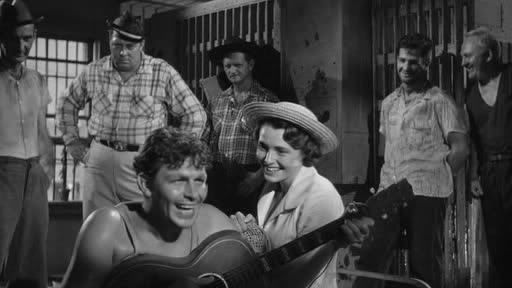
Marcia Jeffries (Patricia Neal) is working at a 2-bit Arkansas radio station when we first meet her. She hosts a man-on-the-street show called - You guessed it – “A Face in the Crowd”, and is just trolling for anything interesting when she happens across Larry Rhodes (Andy Griffith) in the local jail. Hung over and uncooperative at first, there’s a little glint in his eye when he hears the world “radio”….and sees Marcia. He sings a song about life as a hobo, and promptly launches a sensation.

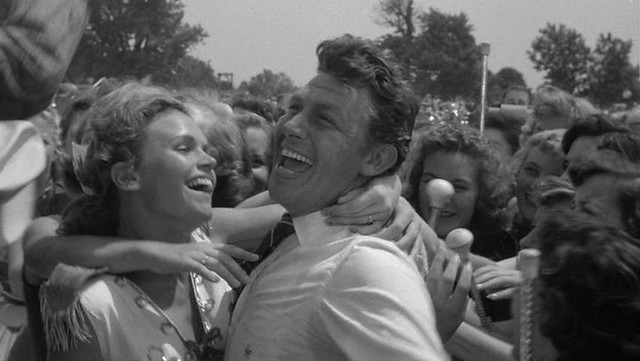
Kazan was one of the great actor’s directors, meaning he could coax great performances out of his people, and AFitC is a glorious example of this. Take the decision to cast Andy Griffith as “Lonesone” Rhodes. He was not a star at that time – he was just a lesser known stand-up comic best known as a cast member of Steve Allens' show. Casting him in this role, which is so loud and over-the top was a huge risk, but in looking at the film, it’s perfect. Rhodes’ laugh is so aggressive that it takes his whole body to do it, but Griffith pulls it off.

Neals’ Marcia is also special. Patricia Neal was an actress who was not really a classic beauty, but who somehow managed to convey a smoky, grown-up sensuality. (For a great example, watch Hud sometime). Marcia is a small-time girl working in a small market, but you never doubt for a minute that she’s smart and capable of much, much more. That’s why she and Rhodes hit it off so well. She immediately sees him as the ticket to where she wants to go. When Rhodes uses his show to play a nasty practical joke on the sheriff who threw him in jail, she thinks it’s hilarious.
 
 
The character of Lonesome Rhodes is a homespun hillbilly populist, much in the vein of Will Rogers, and Rhodes uses the hick persona to his advantage. He knows what buttons to push. A notable early scene has him pull a black woman off the set and tell her story on the radio. He implores the audience to send 25 cents each to help her out, and they do. The legend grows.

The relationship between Lonesome and Marcia is complex, and is the spine that the whole film is built on. He loves her as the one person who really understands him. Although Lonesome is basically a clown and braggart, when he is with her, he becomes real, and we like him. She is amused by him, at first, but gradually grows more attracted to him, and by what she sees as his pithy, straight from the hip way. When the seduction comes, it is HER who initiates it, not him. She humanizes him, and her love of him absolves him in our eyes for the nagging distrust we feel about him.

There is one character, however who doesn’t quite buy into the growing legend of Lonesome Rhodes, and that is a writer named Mel Miller (Walter Matthau). Matthau plays Miller as one of those great cynical types who just kinda knows what is happening behind the smoke-screen, and he drops a line early on that is telling:

“You gotta be a saint to stand all the power that little box can give you”

 
Watching Matthau in this film makes you appreciate just how good he was, and what a shame it was that he so often got pigeonholed into Oscar Madison-like “basset hound” roles. Matthau was a smart actor when he got the chance, like as the Cold War hawk in Fail Safe, or his bank robber title character in Charlie Varrick. His Mel was one of those rare occasions that he got to break out and run with something different.

The film starts to take on darker overtones when Lonesome goes to judge a baton twirling contest and becomes enthralled with young Betty Lou Fleckum (Lee Remick). When you watch him devouring the nubile high school girl with his eyes, you start to get a sense of the soul-destroying corruption eating away at him. He runs off to Mexico and marries the teen, mere days after he has told Marcia that we wants to marry HER.


Lonesone is called upon to help facilitate the political career of a dull Congressman with designs on the White House (Marshal Neilan), and oversees him gettin’ a nickname and a hound dog. By now, Rhodes is thinking even larger than being a radio and TV star. He now sees himself as a political titan, able to become the real power behind a President, and is remorseless in dealing with anyone in his way.

The sequences that close the film are darkly ironic and pitch-perfect, as Lonesome is brought down by the person he would have least expected, and by the medium that made him a star. Griffith has a speech in his penthouse at the end that is so overwrought and extravagant that it inches right up to farce - And then jumps on over. That’s what Lonesome is, however – He’s a “Demagogue in Denim”, as Miller calls him, with the pedal to the metal at all times. As he replied early in the film when Marcia remarked that he put his whole self into his laugh:

“Marcia, I put my whole self into everything I do!”


Saturday, December 08, 2012

Moments of Distinction


The Film – Shadow of a Doubt, dir. Alfred Hitchcock

The Set-Up – Serial murderer Uncle Charlie (Joseph Cotton) prepares to flee the law and go hide out with his sisters’ family.

This sequence is here because it is such a great illustration of Hitchs’ command of film language, and how he could manipulate the viewer. The first shot is of Charlie in his room, relaxing. Money is strewn about the place. Somehow, you just know that the reason for it being there is terrible. His landlady comes into the room, and he is icy and distant with her, until she remarks that there were a couple of men asking about him. Without giving us any real detail, Hitchcock has told us a great deal.
 

Now flash to the idyllic little town of Santa Rosa, and the family of his sister. We visit his niece Charlie (Teresa Wright), as she rests in HER room. The thing that is interesting in seeing these two shots is that they are virtually the same, but they are facing in opposite directions. It’s a clever way of establishing that there is a bond between these two people (she is named after him), but that they are different in some fundamental way.

 
The other portion of the opening passages that I admire is a small sequence regarding a telegram. The family gets a phone call about a telegram. When the phone rings, we can already surmise that it is related to Uncle Charlie.  The youngest daughter answers the phone, but only after letting it ring several times. After answering it, she doesn’t take a message. When the mother calls the telegram office for the message, the children pester her and make noise in the foreground.  What Hitchcock was doing here is creating discomfort in the viewer. We want to know what is going on, and all the distraction and cacophony makes us a bit uneasy. It’s a sly way of adding tension to a situation that logically should have none.

Monday, January 09, 2012

Saturday Night and Sunday Morning

Karel Riesz’ Saturday Night and Sunday Morning (1960) is a testy, petulant, balled-up-fist of a movie. It’s portrayal of a young factory worker struggling to keep his life from sliding into a sea of boredom and ennui is one of the vanguard films of what was to become known as the British New Wave in the early sixties.

Arthur Seaton (Albert Finney) is a Nottingham lad who has two facets to his life. By day he labors at a bicycle factory – Nights and weekends, he’s at the pub. Albert has a definite edge to him, that’s plain to see. Watch his swagger when he hits the town in his stylish suits or the smug way he exhales cigarette smoke. He’s a likable rogue, and it’s easy to imagine women being drawn to him.

Brenda (Rachel Roberts) certainly is. She’s with him as the film opens, and if the fact that she’s married bothers either of them, it’s hard to tell. That’s the thing about the blue-collar world of SN&SM – The people are beaten down by life, and they don’t seem to give much thought to anything outside their own orbit. Arthur likes this woman, and is romantic with her, but one doesn’t get the sense that his investment in her runs very deep. For her part, Brenda gives no indication that she wants out of her marriage (to a co-worker of Arthurs) – It’s more like she just feels a bit more alive when she’s with this wild young man.

This was Albert Finneys’ first starring role, and he is electric as Arthur. The role calls for Seaton to be a charming cad, but also to be selfish and thoughtlessly cruel. That is a hard package for any actor to shoulder, but Finney pulls it off beautifully. Watch him as he woos the pretty young Doreen (Shirley Ann Field). He is almost insanely cheeky and confident as he pushes through her defenses, and by the time the conversation is done, he’s got a date with her.

The thing that elevates this film to masterpiece, however, is the world that Seaton occupies. This is working class England in 1960, and the film illustrates a country still trying to regain its footings after the devastation of World War II. Most of the guys in the factories and pubs would have been veterans, and they are realizing that the better England and better lives that they hoped to find after the war aren’t going to be there. The cinematography by the great Freddie Francis helps add shading to the feeling of societal malaise that pervades the film. Everything looks sooty and worn out.

That’s the life that Arthur is terrified of. He tries to live his life as a rebuke to all of this, and says so at every opportunity.
“That’s what laws are for. To be broken by blokes like us!”
“Think of number 1. Share and share alike’s no good.”
“I’m out for a good time – All the rest’s propoganda!”
Arthur talks tough, but it’s hard not to see that he’s an empty shell. The idea of marriage amuses him, and we already know that fidelity and loyalty are foreign to him. He lies to every single solitary person that he encounters in this film, and seems to have no guilt about it. For all his bluster, Arthur realizes that he is probably going to end up just like those poor blokes that he so despises.
The film seems to reach a turning point when Arthur finds out that Brenda is pregnant by him. His reaction is what we might expect – That she has to “Get rid of it”, and it’s in these exchanges between Arthur and Brenda that the true soul of SN&SM resides. Arthur is supportive and not completely unsympathetic to Brendas plight, but the thought of the baby fills him with dread. It’s an inconvenience.

For her part, Brenda is the films most tragic character. Send by Arthur to see his aunt about an abortion, she comes back with a pitiful tale about being told to “Sit in a hot bath and drink gin.” She has allowed herself to become close to an attractive but irresponsible playboy, made a mistake, and now finds herself abandoned by him. She also faces the prospect of going to her husband with the truth about her pregnancy. When she confides to Arthur that she is going to keep the baby and confess her infidelity to her husband, it’s a beautiful, brave scene.
Near the end of the film, there’s a line that Arthur throws out about his parents that seems heedlessly cruel and unfair. When his cousin remarks that they seem happy, Arthur shoots back “They’ve got a TV set and a pack of fags, but they’re both dead from the neck up.” - Meaning that they have fully surrendered and are just marking time until death. As harsh as that sounds it’s not really wrong for most of the people we see. When Arthur encounters Brenda’s husband near the end of the film, instead of anger and violence he gets sadness and resignation. The man doesn’t feel the need to vent on this punk who cuckolded him, and this amazes Arthur. He would have respected the man more if he had tried to fight him.
The final passage of SN&SM is quiet and reflective, and anticipates what Arthur has fought his whole life against. Arthur and Doreen walk to a grassy hillside overlooking rows of factory houses, and Arthur remarks that when he used to come up there when he was a kid, there were no buildings. As the couple talks about getting married, Arthur hurls a stone at one of the houses. Doreen admonishes him saying “That could be our house” and Arthur replies, “It won’t be the last one I throw” By now, Arthur is starting down the path to surrender himself, and he knows it. Just like the blackberries gave way to urban sprawl, his youth will ebb away, and he will be like the rest. Dead from the neck up.

IMDb

Amazon


Saturday, November 26, 2011

The Movies of My Life

Jacques Tati’s Playtime (1967) is a film that I find myself returning to every two or three years. If pressed to tell you why, I’m not sure I could. Not with any degree of firm conviction, anyway. To say that it is a comedy is correct, on the face of it, but if you watched it expecting belly laughs like you might experience with, say, Laurel and Hardy, you’d be disappointed. I have seen it at least 4 times, and I have never really laughed out loud at anything onscreen. Playtime’s pleasures are more quiet and sly than robust.

I ‘ve always had this little crazy theory lurking in the back corners of my mind that Jacques Tati got the inspiration for Playtime from an ant farm. Yeah, an ant farm – That thing with a colony of ants sandwiched between two plates of glass. That’s what I feel like when I watch Playtime: It’s an observation of a species.

Tati had already has a big hit with Playtime’s predecessor Mon Oncle, which takes a look at the impersonal modern world, as M. Hulot struggles to cope with a futuristic house. As good as Mon Oncle is, it’s view of the modern world is a tad sour. Playtime, on the other hand, can be seen as a celebration of humanity on the face of the onslaught of modernism.

The film revolves around M. Hulots experiences in a world of glass and concrete. Early in the film, he has an appointment with some bureaucrat for some reason or another. This is one of the first of the film slyly humorous scenes. Hulot waits while an elderly security guard punches numbers into a huge bank of buttons and lights. He sits and waits, and finally we start to hear the clicking of shoes on a hard floor as the camera looks down a long corridor. Finally, a speck appears at the other end, and the man walks up to meet him. To describe this scene does it no justice, but in seeing it in a theatre, the ludicrousness of the little man, the long, long hallway, and the clicky shoes is disarmingly funny. It’s a normal human being doing a normal thing in an absurd scenario.

Take the sequence where Hulot is told to wait before the guy sees him. The waiting room is a glass cube, which is funny enough, but the walls are festooned with portraits of stern authoritative types, who all seem to be looking at him. Hulot can see the world outside, others can see him, but he’s still like an ant under glass.

It would be wrong, however, to assume that Playtime is just a cute broadside against the modern world. To be sure, it isn’t an accident that the architecture is presented the way it is – Cold grays and blues, and right angles everywhere. Tati compensates for this with the people that he populates this world with, however. They aren’t cold automatons, but rather a living community. The subtle message of Playtime seems to be that even in this austere world, there is poetry. Whether it’s a man doing a bizarre ballet atop a rolling office chair, or an angry man slamming a noiseless door, Tati never makes his folks less than human.

The film tradition that Tati belonged to was that of the great silent comedians, like Charlie Chaplin, Buster Keaton and Harold Lloyd. More than any other characteristic of Playtime (and of M. Hulots Holiday, and Mon Oncle), I love his brazenness in essentially doing away with dialogue in his films. You can hear people talking in Playtime, like the gaggle of American women, or the little security man I wrote about earlier, but it really doesn’t matter what they say. The construction of he film is so clever that dialogue is completely irreverent.

The centerpiece of Playtime is an extended sequence at a posh new restaurant where just about anything that can go wrong, does. As the time for the party approaches, work crews are literally just finishing up the contraction, and there is a running gag about a floor tile that doesn’t want to stick. Look at the patrons of this place as they start to flow in – They are all well dressed, affluent and perhaps somewhat uptight. Being uptight just won’t do in this movie, however. Tati brings several gags to simmer simultaneously during this sequence. There’s a fish dinner that never seems to get to the correct person. There’s a waiter with a torn coat that the others come to borrow stuff off. There’s a serving window that is too small to pass a dish through. All this stuff is whirled together as a jazz band plays, and gradually you notice that everyone has loosened up and packed the dance floor. The rowdiness builds and builds until Tati finally boils it over, and then brings it all back to earth in what is probably my favorite Tati scene.

Tati doesn’t really believe in bad guys, and that helps give his films that sweet glow that they all carry. With no real rooting interest in the outcome, you just sit back and observe. This was always in evidence in Tati’s films, but in Playtime, it’s carried to its logical conclusion. Although the film ostensibly centers on M. Hulot, he isn’t really the “star”. Playtime is much more diplomatic than the earlier stuff in the way the focus is distributed. The American lady played by Barbara Dennick is essentially as important to the film as Hulot, and others get significant screen time, like a fun-loving loud American diner, and the long-suffering headwaiter.

Playtime doesn’t end with bang, either. There are no great romantic moments, no revelations, and no grand comic flourishes. After spending the raucous night at the restaurant, the people just quietly go their own ways. I couldn’t have made that ending sound more boring, but Playtimes closing passages are pitch-perfect. The tourist ladies climb into their bus, and they meld back into the city. The bus joins into a roundabout with all makes and shapes of other vehicles. It’s instructive to notice that after bathing most of the rest of the film in sterile grays and blues, that this scene is a cacophony of color and noise.

That brings home to me what I love so much about this movie, and about Jacques Tati. Even in a cold mechanical world, people are people, and they’re the best things going. You just have to look.

IMDb

Amazon

Roger Eberts Great Movies

Cinema Styles on Playtimes’ color palette

My essay on the restaurant scene