Wednesday, May 11, 2011

Jacob's Ladder

Adrian Lynes Jacob’s Ladder is a maddening dervish of a movie. It’s dark, nervous, and soaked through with hallucinogenic angst. One could watch it through ten times in succession and still not have a grasp of what you have just seen. Despite all this, it works wonderfully as a portrait of a man’s descent into madness.

The Jacob of the title is Jacob Singer (Tim Robbins), a well-educated Viet Nam vet now working as a mailman. The film starts with a flashback back to the jungle, as Singer’s platoon is ambushed and suffers devastating losses. Singer himself is bayoneted and almost dies.

Pitch forward to the present, and Singer is now working in a post office, and living with a co-worker played by Elizabeth Pena. There are signs early on that there are some cracks in his psyche. Singer awakens from the Viet Nam flashback to find himself in an almost abandoned subway train. He asks a lady for help, and she is so silent and strange that it is frightening. That’s not the real kicker however – A cursory glance at a sleeping bum seems to reveal a tail like a serpent. These images defy logical explanation – This guy must be nuts, right?

Some more info is introduced. An old photo of Singers now-dead son Gabe (Macauley Culkin). We start to learn about his shattered marriage, and the tragic loss of this child.

A character from Singers past comes into play – A platoon-mate named Paul, who suffers from the same nightmarish visions. This starts to skew our view of what we are seeing, and when Paul’s car explodes in a ball of fire, it’s evident that there are more layers to this story.

The movie calls attention to the Biblical names of the main characters, and it’s interesting to investigate this in the context of the story. Jacob was the son of Isaac, and was known for having wrestled an Angel whilst on his way back to meet his estranged brother, Esau. The movie Jacob is wrestling, too, and a comment made by Jacob’s chiropractor (Danny Aiello) circles back to the biblical Jacob. “If you're frightened of dying and you're holding on, you'll see devils tearing your life away. But if you've made your peace, then the devils are really angels, freeing you from the earth.”

Then there’s the case of Singers’ woman Jezebel. The name has become synonymous with deceit and treachery, and it’s not by accident that the character has this name. It is, however, a little hard to get a firm grip on Penas’ Jezebel. She’s got a streak of treachery in her, like when she incinerates Jacobs photos of his family. On the other hand, she does seem to genuinely love him, and saves his life at one point. Like I said, she’s hard to pin down.

It’s hard to gain a toehold in this film, because Lyne doesn’t ever give you a chance to reliably stand back and decide what is real. There are passages that are plainly hallucination, sure, but he doesn’t stop there. After Jacob almost dies, and is revived, he is suddenly back with his family. It would be reasonable to assume that the previous events are imagined, but then the screenplay does a sly thing – it has Jacob jokingly reference the hallucination. “You know Jezebel from the post office? I was living with her! She had these fantastic thighs..” I found this scene not reassuring, but disorienting, like I was being teased with another layer of fog.

There’s a scene where Aiello rescues Jacob from the hospital, and again, what seems like a reprise from all the madness and disorientation actually raises a lot of questions, like how did he know Jacob was there, and how does he just waltz in and take him away? I felt the film was maybe pulling a sleight of hand on me.

I’m making this movie sound like an impossible slog, aren’t I? It IS difficult, and disorienting, but it is to its’ credit that it manages to maintain its narrative drive, as Jacob plows forward in his quest to find out what is happening to him. There is a shadowy character that we have seen briefly who seems to be following Singer, and eventually, the two men meet face-to-face. It’s here, in a barren alley that the fogs lift, as Jacob learns about a hippie chemist who made a deal with the Army to stay out of jail, and how the job he was given went horribly wrong.

This final revelation seems to lift the cloak off of Singer, and as he goes back to his old home, which seems strangely preserved in time, we think back to what the chiropractor said “If you’ve made your peace, the demons are angels freeing you from the earth.”

I spoke above about the preponderance of Biblical names in JL. The one I failed to touch on was Jacobs’ dead son Gabe (or Gabriel). The Biblical Gabriel is an angel, who is considered a messenger from God. Thus, when Jacob encounters his son again in his old home, we know why the child is there. This passage is beautifully soothing after everything we have gone through with Singer, and the expression on the man’s face as his son speaks to him is absolutely perfect – It’s sadness, recognition, love, peace, fulfillment, and relief all rolled into one divine smile.

For all the misdirection and twists in this story, however, JL saves the biggest till the last. An epilogue flashes back to Viet Nam and we encounter Jacob after he has been brought to the hospital. Theories abound about what this scene means. Is it an hallucination? Is it what really happened, and everything we have seen the hallucination? I have my own theory about it. Coming immediately after Jacob has again encountered his dead son, I think that this scene is a “reboot”, where Jacob has somehow erased all the pain and paranoia of his post-war life. Just have a listen to the song playing in the background during this sequence. The singer is Al Jolson, and the song? The song is "Sonny Boy".

Sunday, May 01, 2011

The Art of Showing Nothing - An Interview with Robert Bresson

This is another interview from Charles Samuels landmark book Encountering Directors. Samuels spoke to Bresson in 1970, and the two covered most of Bressons’ work to that point in this lengthy conversation. Samuels’ discussions are notable in that he actually has the balls to tell these great filmmakers how they might have done their job better. Enjoy.

My Week of Movie Watching

This is actually a few weeks worth.

The Kings Speech – It’s like someone sat down with a “How to win an Oscar” kit and put this movie together. First of all is the lead character with the disability (Much like Rain Man, Forrest Gump, My Left Foot, etc). Add in sumptuous costumes and set designs. Add a couple of high-profile stars in Colin Firth and Helena Bonham Carter, and fill in with the cream of Brit character actors (Michael Gambon, Derek Jacobi, Timothy Spall). Yeah, it’s easy to look at this film and be cynical, but I have to say I still enjoyed it. I never knew the story of King George and his stuttering, and the way that the abdication of Edward VIII is woven in is well done. Guy Pearce is terrific as the monarch who gave it all up. Recommended.

Mouchette – I always have hits and misses with the films of Robert Bresson, and this is one of the latter. The story concerns a troubled French girl, her dying mother, and her abusive father. Mouchette’s life is a hard one, and it gets worse as she suffers a rape at the hands of a man she trusts. Bressons’ protagonists are always tight-lipped, and Mouchette maybe more so that any other. The films’ heartbreaking finale will leave you grasping for answers. I sort of recommend this, but I don’t put it in the class of the great A Man Escaped, which I consider Bresson’s masterpiece.

Proof – Little-known Australian film from the early 90’s concerns Martin (Hugo Weaving), a blind man who takes photos of his everyday life and has a friend (a young Russell Crowe) describe them to him. There’s also a housekeeper (Genevieve Picot) whose relationship with Martin is a jumble of sexual attraction and calculated cruelty, and who begins a clandestine affair with Crowe. This film is low budget, and looks it, but it redeemed by stellar performances by the three leads. It’s definitely worth a look.

Friday, April 29, 2011

Between the Covers

Wheeler Burden did not think of visiting Berggasse 19 until the third day in Vienna, or at least there is no mention of it in the journal he kept with meticulous care from almost the moment of his arrival. The first days he spent adjusting, you might say, to the elation of newness and the spectacle of this city he knew so well in theory but had never actually visited. Then the practicalities settled on him, followed by a deep feeling of displacement. Wheeler was a long way from home with no means of either identification or support. But before the gravity of the situation set in, he was almost able to enjoy himself. Much of the first day, of course, he was busy marvelling at his mere presence in such a magnificent and imperial city. It was 1897 Vienna, after all. The first hour, we learn from the journal, he spent clearing the fog from his mind and pulling himself painfully back to full awareness, emerging from the miasma of what seemed like a long uneasy sleep, and from the catastrophic precipitating event he was nowhere near ready to remember.

Wheeler wakes up one morning and finds himself transformed to 1897 Vienna. If that premise makes The Little Book sound like a Back to the Future-esque bit of triviality, rest easy. Guided by the notes of his old teacher, the venerable Anaud Esterhazy, Wheeler unravels the mysteries surrounding his family; His war-hero father, who was murdered by the Gestapo and his beautiful, yet repressed grandmother. Also making appearances are Sigmund Freud, Gustav Mahler, Mark Twain, and an eight-year-old Adolf Hitler. Turn of the century Vienna is captured beautifully here: A vibrant city of art and music, albeit one rife with an anti-Semitism that would plant the seeds for the horrors to come 40 years later.

An article on the creation of The Little Book, which was a decades long labour of love for author Selden Edwards.

Wednesday, April 27, 2011

Sex

Britt Ekland

Friday, February 25, 2011

Tuesday, February 22, 2011

The Marquee

Cloak and Dagger

Sex

OK - THIS is Lilli Palmer

Thursday, February 17, 2011

Sex

Lilli Palmer

Tuesday, February 08, 2011

Wednesday, January 19, 2011

Friday, January 14, 2011

My Week of Movie Watching

Iron Man 2 – A disappointment. The original is my favourite comic-book adaptation, so the sequel had its work cut out for it, but some of the failures are mystifying. First, take the villain Whiplash (Mickey Rourke) He’s a great invention, and the sequence where he attacks Tony Stark on the racetrack is terrific. But then he has no contact with Iron Man until the finale, and it is over all too quickly. The OTHER villain, the arms dealer played by Sam Rockwell can’t be taken seriously. Shouldn’t a villain seem formidable? Too much of this film was just empty sound and fury. I longed for a classic comic-book moment like the one in the first film where the prototype Iron Man emerges from the cave. Not really recommended.

Street of Shame – Another in Mizoguchis “Fallen Women” series. This one deals with the denizens of a Tokyo brothel in the post-war period, and focuses primarily on the financial hardships they face. The film features a back-story about a piece of legislation that would outlaw prostitution, and it’s striking to see the dilemma its passing would present. Most of the women hate the degradation and shame attached to their life, but they also realize that if the law passes, they have no other prospects. Poignant, sad, and heartily recommended.

My Architect – This documentary follows the efforts of filmmaker Nathaniel Kahn to learn more about his father, the renowned architect Louis Kahn. The film doesn’t arrive at many answers about the brilliant but erratic father, who had three separate families and was found dead in a train station. The real appeal of this film is in its presentation of the mind of a flawed visionary, who could create stunning works of art, but often had no clue about the practical aspects of his craft – Or of his family. A treat for an architecture junkie like myself is the exploring of some of Kahn’s major works, primarily the National Assembly Building in Dhaka, Bangladesh.

Fort Apache – The first movie of John Ford’s “Cavalry” trilogy is a re-working of the George Custer story. Henry Fonda stars as Colonel Owen Thursday: A cold, brittle megalomaniac whose hubris results in the needless deaths of he and most of his men. John Wayne plays Captain York, who has a more sympathetic view of the Apache nation. On the plus side here are the performances of the two leads, and some magnificent shots of Utah’s Monument Valley. On the minus side is Fords penchant for salting his films with clunky comedic elements. In this case it’s a cadre of hard-drinking Irish sergeants, led by Victor McLaughan. As much as I admire most of Fords work, the man just had no instinct for comedy. A lukewarm recommendation.

Friday, January 07, 2011

Sex

Ava Gardner

My Week of Movie Watching

Black Swan – My only previous exposure to the work of Darren Aronofsky was Requiem for a Dream. Although I admired that film for its technical excellence and its go-for-broke storytelling, I have to admit that it left me depressed for days afterward. Thus, I went into Black Swan with a bit of trepidation. It turns out that BS is a great film, albeit one that also gets inside your head and stays there. Natalie Portmans performance as the doomed ballet dancer Nina is really a tour de force. It would have been really easy for an actress to look ridiculous in this, but she pulls it off. Vincent Cassel as the controlling director is worth a shout-out, as well. Barbara Hershey stars as Portmans controlling mother in a performance that has distinct Bergman-esque overtones. Recommended.

Kagemusha – First time seeing this Kurosawa epic. This one always gets grouped with Ran, and the two films tread similar ground. Both concern great dynasties that crumble due to arrogance and pride. Kagemusha follows a petty thief who is recruited as a double for a slain warlord. The films' central point is that it doesn’t really matter who is leading the clan, and that the warlord is strictly a figurehead. The climactic battle scene is really a marvel, as waves of men are sent into battle, only to be cut down. A masterpiece.

The Hitch-hiker – This Ida Lupino B flick from 1953 is a great example of a film being greater than the sum of its parts. Two fishermen (Edmond O’Brien and Frank Lovejoy) pick up a psychopath hitchhiker. That’s the movie. There is little interplay between the two men as to how to get out of their predicament. So, why does this movie “work”? The film develops it’s tension around whether the men will be able to get rid of the killer before the police realize he is with them, at which point he kills them and moves on to another poor soul. The reason this film works so well despite it’s lack of sophistication is the presence of William Talman as the mad hitcher. With his Jack-O-Lantern smile and his lazy eye (He sleeps with it open!), Talman’s Emmet Meyer is a truly unsettling presence - a low-rent cousin of Richard Widmarks’ Tommy Udo. This is not a great movie, but it’s sure a fun one. Recommended.

A pretty good week.

Tuesday, December 28, 2010

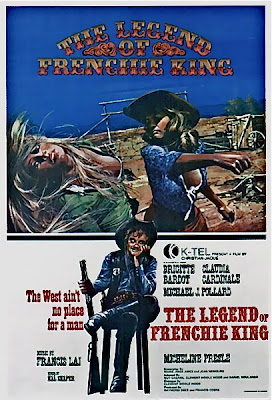
The Marquee (BB Division)

Not a great poster, but hey, Bardot and Cardinale in the same film!

Now THIS is a great poster.

Sunday, December 26, 2010

Friday, December 24, 2010

La Bete Humaine

In a just world, the three central characters of Jean Renoir’s Le Bete Humaine would never have met each other. Individually they are all decent people, but together, they form an admixture of jealously, lust, adultery, madness, and finally, murder.

Lantier (Jean Gabin) is a rail engineer who has no discernable life outside of his work. He even maintains that he is married to his locomotive. The opening credits allude to dark demons inside him, but they are nowhere to be seen as the film opens. Robaud (Fernand Ledoux) is a stationmaster married to Severine (Simone Simon), who seems a bit too young and beautiful for someone like him. Nonetheless, when we first meet these people they all appear to be content.

The “event” that starts the dominoes tumbling is insignificant - Robaud berates an unruly passenger who turns out to be a powerful businessman. Fearing that the man will make trouble for him, Robaud asks Severine to ask her wealthy godfather to intervene on his behalf. She does, but instead of moving forward, Robaud becomes obsessed with exactly what price his wife paid for his peace of mind. As he questions her, it becomes clear that Robaud has his own demons, and the contrast between the doting husband of the films opening and the violent cuckold presented here is startling.

Robaud decides that the godfather has to die for his sin, and has Severine arrange a rendezvous on a train. Robaud ambushes the adulterer in his compartment and stabs him to death. What I find fascinating about this crime is the motivations for binding his wife to the murder. She is present during the murder, and besides the fact that her involvement ensures her silence, there is also the idea that by killing her lover in front of her, he is rubbing her face in her infidelity. Severine, for her part, does not react with quite the horror and revulsion that we might expect. More like quiet resignation, perhaps, like she is somehow accepting of the penance.

The murder goes smoothly, except for one detail. When the killers emerge from the cabin, there is someone there, casually having a smoke – Lantier. The moment when the two confront Lantier in the narrow corridor is filmmaking at it’s best, as Severine sees him first, then Robaud gradually comes to the realization that she is looking at something, and then it hits them that this thing just got a lot more complicated. When the murder is discovered, Lantier starts to realize that he knows who the killers are, and that they must suspect he knows. When the police question him, he inexplicably says he saw nothing.

Lantier is the wild card here, and the killers are forced to make him an ally. The thing is, they can’t even begin to imagine the baggage their new partner has. As I mentioned above, the opening credits tip us off in advance about Lantier, and how he felt he was paying the price for the sins of the generations before him. It’s not immediately clear what that means, however. He seems normal enough with his railway buddies, but it’s in a meeting with an aunt early in the film that we start to see inside him. He encounters a girl who we surmise he has been involved with in the past, and as they draw close to a sexual encounter, he is suddenly overtaken by an impulse to kill her, but snaps out of it in time. In modern terms, we would say that Lantier is bipolar, and this knowledge casts new light on his loner lifestyle.

Now skip back the scene where the police interrogate him after the murder on the train. As he begins to talk, he makes eye contact with Severine, and Renoir lets the image of her face go out of focus for a second. It’s barely noticeable, but it’s a telling point of view shot that establishes a couple of things: First, that Lantier is attracted to this beautiful young woman, and second, we are seeing a possible hint of one of Lantiers murderous “black-outs.”

Severine starts a tentative friendship with Lantier, at first to ensure his complicity with the murder, but it gradually develops into some thing far more serious - a full-blown love affair. It’s during the development of this relationship that we start to see Severine more clearly. The two men have their issues, obviously, but what about her? Severine has her demons, as well. Trapped in an abusive marriage, she turns to another man who has the potential to be even worse. She seems to have a tendency towards self-destructive choices. During her time with Lantier, he shows an alarming fascination with the mechanics of the murder, but this doesn’t set off any alarms for her.

Lantier and Severine form a strange co-dependant union. She sees him as her salvation from the tyranny that she faces with her husband. He, in turn, probably believes that she can deliver him from the violent impulses in his head. It’s no surprise then, when these two damaged people decide to get rid of the one obstacle that keeps them apart – Robaud.

Lantier, however, finds himself unable to go through with it, and that tragically changes the dynamic with Severine. She looks at him differently from then on, and essentially ends the relationship. It’s only a matter of time then before Lantiers demons are released, and he commits an act from which there is go going back. He knows it, too.

It in the aftermath of Lantiers murder of Severine that my favorite images of LBM occur, as Lantier sorrowfully walks away from the murder scene, knife in hand. This is followed immediately by a shot of the broken Robaud standing in the same spot, looking at his murdered wife, and clutching a watch taken from the murdered godfather. It’s a beautifully lyrical way to tie the three principals together, and underscore the way that all three have been destroyed by their base urges.

Tuesday, December 14, 2010

Cool

The Three Stooges (and Fred MacMurray) mug for Joan Crawford

Sunday, December 05, 2010

On Location

Howard Hawks and Angie Dickinson confer on the set of Rio Bravo.

Friday, December 03, 2010

Le Voyage Dans la Lune (A Trip to the Moon)

A contribution to the 1000 Films You Must See Before You Die blogathon hosted by Filmsquish.

When Georges Meiles made A Trip to the Moon in 1902, the Wright Brothers were still a year away from their first flight in Kitty Hawk. Viewed in those terms, Meiles masterpiece of interstellar adventure stands as a remarkable achievement in imagination.

The film, which clocks in at less than 15 minutes, can rightfully lay claim to being the cinema’s first science fiction work, as well as one of the first examples of a filmmaker putting a story on the screen, as opposed to simply filming an activity.

ATTTM is told without subtitles, but they really aren’t needed. The film opens with a group of scientists in a heated discussion, and a blackboard indicates the topic – How to get to the moon. The method is something you might expect them to come up with. A huge bullet-like capsule that is to be fired out of a cannon, but in looking at the craft, it is not dissimilar to that which the Apollo astronauts flew to the moon decades later.

The inspiration and concept for the film came from that great font of futuristic speculation, Jules Verne. His novel From the Earth to the Moon was published in 1865, and like much of Vernes’ work is eerily prescient about out the world to come. Meiles film shares that quality – That pedal-to-the-metal feel of an imagination running rampant.

Putting aside the scientific aspects of ATTTM, it’s also fascinating to consider it as a world of cinematic art. Meiles greatest contribution to film history is that he was the first filmmaker to truly incorporate what we now call “special effects” into the language of film. Stuff like fade-outs are invisible to the eye of the modern viewer, but in this film, in this context, they are magical.

ATTTM is also surely one of the earliest examples of a director focusing on casting, costumes, and set construction. Take for instance Meiles use of female ballet dancers in this film. There’s no reason for the arc of the story for there to be shapely female characters, but I guess they suspected even then that sex sells. Or take the acrobats who play the moon men. Their inclusion gives the aliens an otherworldly vibe which must have made them completely enthralling to audiences watching at the turn of the century.

It’s not hard to watch ATTTM and see how their concept of alien life was taken and expanded upon in countless Sci-Fi films throughout the years. The malevolent creatures of the Alien and Predator movies are direct descendants of Meiles Moon-men in their skeleton costumes.