


Jacques Demy made Lola in 1961, three years before his masterpiece, The Umbrellas of Cherbourg, and you can plainly see the skeleton of the later film being put in place here. Like Umbrellas, it’s world is essentially realistic, but with a tiny current of fantasy flowing through it. It’s like a snakes and ladders game, full characters whose lives run parallel to each other, with similarities that they aren’t aware of.

The title character is a cabaret dancer and single mother played by Anouk Aimee. Lola is a sweet and whimsical type who isn’t above sleeping with the odd guy. When we first meet her, she is in the midst of a little romance with an American sailor named Frankie. The two are playful and kind to each other, but they both seem to regard the relationship as a temporary fling. Frankie mentions offhandedly that he is engaged in the States, and Lola tells him that he looks a lot like a guy she once loved a lot. When she tells him this there’s no doubt that her feelings for the other guy are still pretty strong.
The other main character is living and working alongside these two, unaware of their existence. That’s Roland Cassard (Marc Michel). Cassard is a self-confessed dreamer who can’t seem to hold down a job, and has no idea what he wants to do with his life. As he sits in his café and smokes after losing his latest job, you can feel the ennui coming off him in waves. He listens in to a woman who swears that she has just seen her long-lost son, and he laments, “One day I’ll go away.”
Cassard has a chance meeting in a bookstore with a widow and her teenage daughter, and this leads to a dinner invitation from the two. There’s a complicated dynamic at work in this bit. The mother is plainly attracted to Cassard, as is the young daughter in her own innocent way. Cassard, on the other hand tells the young girl, Cecile that she reminds him of another Cecile that he used to know. We’re starting to get hints of what is to come.

A chance meeting between Roland and Lola occurs on the street – They literally bump into one another – and the threads begin to come together. Cecile, it turns out is Lola’s real name, and she’s the childhood sweetheart that he spoke of in the bookstore. Roland’s boredom dissolves upon meeting Cecile again, and they make a date for that evening. Watch Roland’s body language as he skips away from the meeting and you see a man who believes he may have just been saved.
In Jacques Demy’s universe, however, romance is never simple. We have a young man who is bored with life who falls hard for an old sweetheart. We have a girl carrying on a meaningless flirtation with a young American, mainly because he reminds her of her great, lost love. We have the American, who likes Lola a lot, but recognizes the relationship as just being a lark. We have the widow, who longs for companionship, and as much as tells Cassard so in their dinner together. Finally we have the younger Cecile, who wants to become a dancer, and is enraptured by the allure of freedom and adventure the older men have. All of these people have similar needs – the need for love and companionship, but they’ve all found themselves in situations that make it difficult to achieve them. It’s a theme that resonates throughout Demy’s work.

I mentioned above that there is a current of fantasy that runs through the film. This is brought to the forefront when Lola’s long lost husband Michel turns up after being gone for seven years. It seems like a bit of a contrived plot device that this man who left as a penniless lost soul comes back as a wealthy businessman to scoop up his wife and son. It’s necessary to the arc of the plot, I guess, that Roland’s dream is shattered by this outside force.
There’s a little wink here, however, that you wouldn’t know unless you know The Umbrellas of Cherbourg. In that film, a wealthy businessman named Roland Cassard (played by Marc Michel) comes between Catherine Deneuve and her young lover. In Lola, Roland talked about going off to a small island in the Pacific. Michel tells Lola that he went off to the same island and came back a rich man. You don’t need to have seen Umbrellas to see that Roland’s life is paralleling that of Michel, but it does reinforce the idea. This concept puts a slightly different spin on the film’s poignant final image, as Lola dives away in Michels’ big American car, and they pass Roland on his way to his boat. He’s just another dreamer who has to find his way.
 Catherine Denueve, Francoise Dorleac, and Jacques Demy on the set of Les Demoiselles de Rochefort (1967)
Heston was not the world's greatest actor, but as a "movie star", he had few peers. He was an icon, and he will be missed.
Let’s go back in time a bit. In 1996, the “big” movies - the ones that garnered all the talk and awards were Fargo, Shine, and The English Patient. Virtually unnoticed was a perfect little Sayles jewel called Lone Star, which popped up on a lots of critics’ lists for the year. A murder drama which eschews big stars and violence in favor of spot-on characters and sublime storytelling, it’s an American masterpiece. I think it was the best film of the 90’s.
Lone Star is set in a smallish town near the Texas/Mexico border, where whites, blacks, and Hispanics live together in a cultural gumbo. There are frictions at work in this place, as evidenced by a school board meeting where there are arguments over whose version of local history is going to be taught in school. The film, however creates the palpable sense that these people really have lived together all these years, disagreements and all. That’s the thing about Sayles’ work – He never fails to create a strong sense of place in his films, and LS is arguably the best example.

Sheriff Buddy Deeds has long been dead when the movie begins, but his presence is felt throughout. Deeds was a larger-than-life legend, and in the estimation of the older townsfolk, the current sheriff comes up short in comparison. Especially since the incumbent is Buddy’s son Sam. (Chris Cooper). The film doesn’t quite avoid delving into the relationship between the son and his late father, but it doesn’t put it up front, either. There’s a great scene early on when Sam speaks at a ceremony honoring his father, and there is a definite undercurrent of bitterness in Sam’s words.
The tension between generations is the theme that pervades Lone Star, and it’s interwoven stories are all variations on the same topic. Besides the two Deeds, there’s the all-business Army officer (Joe Morton) who has returned to his hometown to run the local base, and who encounters his estranged father. And finally, there’s Pilar (Elizabeth Pena), the teacher who re-kindles an old romance with Sam to the consternation of her mother. All these story lines could have easily created a mish-mash of a movie, but the film is remarkably fluid.

The murder I spoke of at the beginning involves a long-dead skeleton found on the Army base. An old Masonic ring and a badge are discovered with the body, and Sam begins to realize that the dead man is Charlie Wade (Kris Kristofferson), a murderous redneck who was the Sheriff before his father. As Sam pieces the story together, he begins to suspect that the murderer may well have been his own father.
This theory, of course, doesn’t much wash with the town’s fathers. A fishing-hole encounter with the Mayor (one of Buddy’s old deputies) illustrates this and shows off Sayles talent for writing dialogue that says a lot more than it seems.
“Hey, look at all this, will ya? Tackle, boat... All just to catch a little ol' fish minding his own business down at the bottom of the lake. Hardly seems worth the effort, does it, Sam?”
Lone Star is full of flashbacks – That’s how we get to meet Charlie Wade, and one of the true pleasures of this film is the way Sayles recreates the past. He will hold the camera on characters in the present, and then sweep it away from them to the same characters in the past, without a cut. It’s potentially a confusing technique, but it works wonderfully here, as in a scene with Sam and Pilar fades into a scene with the two as teenagers, and also where a character hiding from Sheriff Wade under a bridge morphs into a shot of Sam standing on the same bridge years later. It’s virtuoso use of the flashback technique.
The denizens of Lone Star are people who have had past events dredged up, and everything they thought they new is altered. Sam’s investigation into the death of Charlie Wade leads him eventually to the truth – But it’s not the truth that we expected.

His renewed love with Pilar isn’t exempt from thunderbolts from the past either. The film drops a revelation on him about Pilar that I will not spoil for you. The film leaves hints about it, but it would take a very astute viewer indeed to catch them. The film’s finale is a wonderful summation of it’s themes, and although the plot would seem to have led the two lovers into a dead end, Sayles pulls it off.
The conversation between Sam and Pilar occurs in an old, deserted drive-in theatre, and it’s beautiful in its sense of regret and longing. The whole thing lasts a few seconds, but it encapsulates years of resentment, deceit, …and love. Pilar’s final three words are so pitch-perfect and simple that they still astound me, even as many times as I’ve seen this.
"Forget the Alamo."
 What's the most you ever lost on a coin toss?
Sir?
The most. You ever lost. On a coin toss.
I don't know. I couldn't say.
Call it.
Call it?
Yes.
For what?
Just call it.
Well, we need to know what we're calling it for here.
You need to call it. I can't call it for you. It wouldn't be fair.
I didn't put nothin' up.
Yes, you did. You've been putting it up your whole life you just didn't know it. You know what date is on this coin?
No.
1958. It's been traveling twenty-two years to get here. And now it's here. And it's either heads or tails. And you have to say. Call it.
Look, I need to know what I stand to win.
Everything. How's that? You stand to win everything. Call it.
Alright. Heads then.
Well done. Don't put it in your pocket, sir. Don't put it in your pocket. It's your lucky quarter.
Where do you want me to put it?
Anywhere not in your pocket. Where it'll get mixed in with the others and become just a coin. Which it is.
No Country for Old Men - Screenplay by Joel and Ethan Coen
As long as we're listening to great Herrmann scores, here's the best of them all - The great, soaring theme for North By Northwest. Enjoy.
One thing missing from my commentary on The Ghost & Mrs. Muir was a mention of Herrmann's gorgeous score. By way of rectifying that, here's the opening credits.

Gate of Flesh (1964) – Another foray into the work of the Japanese maverick Seijun Suzuki. Like him or hate him, Suzuki never bores. This is a tale about a small band of prostitutes who gang together in post-war Tokyo, and try to survive with the help of a strict code of behavior. Their closed world is disrupted by the arrival of a wild ex-soldier. The film is a comment on the societal sickness of post-war Japan, and it’s a nasty one. Some will squirm at its violent /porn depictions of savage whippings and of a cow being butchered onscreen. It’s not an easy watch, but I do recommend it.
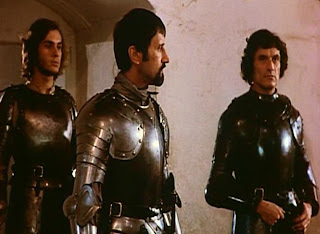
Lancelot Du Lac (1974) – Robert Bresson’s version of the King Arthur saga concentrates on the love affair between Lancelot and Guinevere, and its final tragic consequences. This one is a heavy slog, even by Bresson's standards, as he spends an inordinate amount of screen time on totemic shots of feet, hands, door handles, etc. The film seems to suggest that the pride and arrogance of the two lovers leads to the destruction of the Knights of the Round Table. That’s my best guess ,anyhow.
That line is spoken several times throughout Joseph Mankiewicz’ The Ghost & Mrs. Muir, and it contains the seed which lies at the heart of the film. G&MM is, I suppose, a romance – a love story, but in many ways it rejects the shop-worn concept of living “happily ever after.” It’s a twentieth century take on things.
Gene Tierney is the Mrs. Muir of the title, a recently widowed young mother in turn-of the century London. We first meet Lucy Muir as she discusses her plans to move out of the mother in laws home. She is still technically in mourning at this point, but she displays not a hint of sorrow or sentimentality as she talks to her mother and sister in law. When her late husband’s name is brought up she coolly replies, “But Edwin is dead.” It’s a tiny glimpse, but it illustrates what kind of marriage she is coming off.

She finds herself in a seaside cottage on the ocean, despite the repeated efforts of the local land agent to dissuade her. Despite his comments that “You wouldn’t be interested”, something draws her to the place, and she moves in. Soon enough, however, we see why the property values were so low. This cottage already has an occupant - The ghost of a seaman named Captain Gregg (Rex Harrison). Gregg is not a bad sort, despite his language and gruff manner, and Lucy’s original fear slowly gives way to fascination and fondness for this doppelganger.

The earthy sailor and the prim lady are therefore now living (sort of) under the same roof, and the film winks at the sexual possibilities that come with this situation. At one point as Lucy lies in bed, she hears Gregg intone, “Don’t let anyone tell you that you should be ashamed of your figure!”
The exchanges between these two are what start to really reveal Lucy Muir. Captain Gregg, you see, seems to know everything about Lucy, perhaps more than she knows herself. Consider this exchange about her ex-husband.
“You didn’t love him”
“How dare you say that?”
“Because it’s true. You were fond of him, perhaps, but you didn’t love him.”
Lucy goes on to talk about how Edwin was an architect, “But not a very good one. He couldn’t have designed this house. Who DID design it?” and Gregg replies with satisfaction “I did.” It’s at this point where it becomes plain that the ghost and Mrs. Muir have a kinship that goes beyond mere affection.

Lucy begins writing Gregg’s memoir, marvelously titled “Blood & Swash”, and the film has a bit of fun with the Production Code here. At one point, Lucy hesitates at one word, and only after exhortation from Gregg, does she type it – In four distinct keystrokes. The ghostwriting allows Lucy a look into the exiting manly life of the Captain, and her own life comes up short in comparison. Earlier, when she was with her in-laws, she said that she’s never had her own life, and that sentiment comes up here again. Gregg tells her that she should be out amongst the living, including with other men.
Unfortunately, she gets her chance, in the arrival of George Sanders as the impossibly droll and sophisticated Miles Fairly, a wealthy writer of children’s books. Fairly is handsome and charming, and Lucy falls for him, against the wishes of Captain Gregg. The new man is kind and generous, but there’s something about him that’s not right. Gregg sees it, Lucy’s housekeeper sees it, and we even sort of see it, when he jovially describes the children he writes for as “little monsters.” The ghost is absent for most of the section of the movie involving this romance, and it’s by design, I think. It seems that Gregg is letting her go her own way, even if he thinks she’s making a mistake. Which she is, as she eventually discovers.
So, what to make of TG&MM? Lucy Muir’s story is also the story of how 3 men affect her life. There’s her late husband, and Miles Fairly, both fond of her and kind, although with very little under their surfaces. She ends up feeling unfulfilled by both. Then there’s Captain Gregg. He’s the one who really understands her, and tells her what she needs to hear. The problem is, he’s dead. Why does the film present a love interest that can never really be a love interest? My thought is that the film isn’t really about Lucy’s quest for love, but rather about her quest for emancipation. That’s why Lucy keeps telling people that this is the 20th century. It’s a new era, and the old norms of romance and fulfillment don’t necessarily apply anymore.
The ghost visits Lucy near the end of the film, and as she sleeps, tells her that it wasn’t him channeling the book to her, that it was just her alone. That theory was always out there – That the ghost was just a figment of Lucy’s imagination, and that she found her way to emancipation by herself. The truth is left ambiguous, and I’m glad. At one point early on Gregg recites from Keats’ “Ode to a Nightingale”

“Charmed magic casements, opening on the foam, of perilous seas, in fairy lands forlorn”
That fits Captain Gregg to a T, but go a bit further in the same poem and you find a stanza that might have been written for Lucy Muir.
“Was it a vision, or a waking dream? Fled is that music – Do I wake or sleep?”


Snakes are my life, in a way.
You know how you’ll hear snooty film types lament about how nobody writes great dialogue anymore? Well, it happens to be the truth. The example above could be exhibit A. It’s taken from Preston Sturges’ great 1941 comedy The Lady Eve, and it illustrates what I mean quite nicely. Barbara Stanwyk as Jean and Henry Fonda as Charles (“Hopsie”) are two people who find themselves in love when neither expected to be, and we see it blossom right before our eyes. In only a few minutes of screen time we see nervousness, intelligence, charming silliness…and finally, lust.
It’s fun to watch the great screenplays of the Hays Code era, and watch how writers slyly dealt with sex. Sturges was a master at it, whether it’s Betty Hutton’s one-night-stand in The Miracle of Morgan’s Creek, the two horny spinsters in Sullivan’s Travels, or Barbara Stanwyck playing with Henry Fonda’s hair while making snake talk. Because , you see, they don’t write stuff like that anymore.

Henry Fonda, Preston Sturges, and Barbara Stanwyck on the set of The Lady Eve
This blog got started way back when because I was getting an itch to do a bit of writing. I had been poking around Usenet in the film groups and had tried my hand at some short commentaries, and this had whetted my appetite for more of the same.
It was about at this time that the concept of the weblog started to really gather steam. A Usenet acquaintance named Tom Sutpen had started his own blog, and as I read it, I began to think why not? This was the perfect forum for what I wanted to do – To write about something I was passionate about. Thus, filmscreed was born in the fall of 2005, featuring an essay on Kon Ichikawa’s Fires on the Plain. My intent was always to do commentaries on off-the-beaten-track stuff, just like my blog description says.
I was trying to sit down, do the toil, and perhaps create something worthwhile. In looking back at those first entries, I see that they were far from perfect, but they were at least created with enthusiasm. After a while, however, I started to be bothered by the small number of responses I got, and I began to think that doing an entry every two or three weeks wasn’t enough, that people needed a more steady diet or they’d get bored.
That’s when I decided to start supplementing the blog with photos and film posters, thus keeping a more steady flow of material out there. This was interesting, and it was kind of fun to hunt up stuff to put online.
The change was gradual, and it was abetted by some changes in my life. A new job cut drastically into my free time, making watching movies a lot more difficult, and writing about them nearly impossible. The result was that the blog became saturated with “quick & easy” stuff – Photos, movie posters, magazine covers, and writing took a backseat. When I did write, I had to cram it into the rare bits of free time I had. The quality suffered for it, culminating in the piece I did on Underworld Beauty a few weeks back. It was sloppy, I wasn’t happy with it, but I posted it anyway.
So, now I have made a decision. I briefly thought about just shutting down the site, but decided that that wasn’t an option, so I am just going to dedicate myself to re-inventing filmscreed the way I originally envisioned it – An "insufferable film snob" writing about movies. The posts will be more infrequent, and the film posters and other images aren’t going away completely (I’ve got waaaay too many of them on my hard drive, and I’m not going to have done all that for nothing, dammit!) but the focus will be put back on me sitting at a keyboard and hammering out my thoughts on movies.
If you are one who reads this blog with any regularity, I hope you continue to. I've got a lot of stuff that I want to talk about, and a lot of work ahead of me. Please, just be patient with this time-challenged amateur scribbler.
Thanks
Jeff


