 Fort Apache, 1948
Sunday, September 24, 2006

Wednesday, September 20, 2006
Moments of Distinction
The Film – The Bad Sleep Well, dir. Akira Kurosawa, 1960
The Set-Up – Yushiko (Kyoko Kagawa) has finally discovered that Nishi (Toshiro Mifune) has only married her as a means to getting close to her father, who has caused the death of Nishi’s father.
Nishi looks away in guilt as Yoshiko confronts him about his quest for revenge.
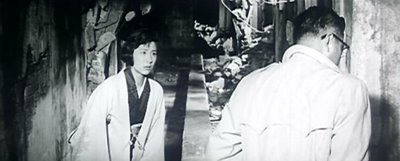 She turns away. Her disability is accentuated.
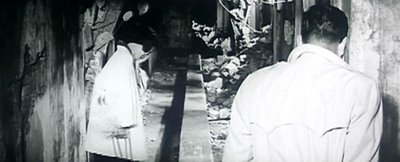 Nishi goes after her, feeling remorse for this woman who he has used. It's the first time that Mifune's Nichi has seen himself as anything but a righteous avenging angel.
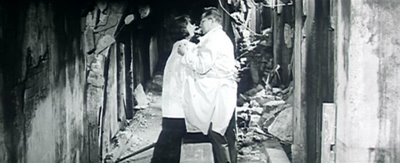 They kiss. Note the bench between them.
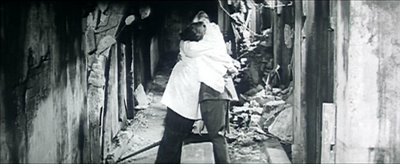 They drop to seated positions.
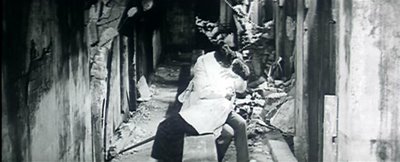 Nishi now gets up; Yoshiko tells him that despite everything, she can’t hate her father.
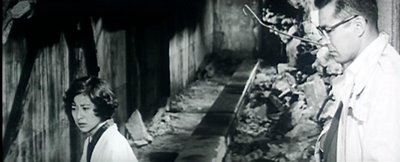 Nishi sits, facing away from her now, and tells the story of his illegitimate father, and his suicide. During the course of this monologue, any possibility of pity dissolves.
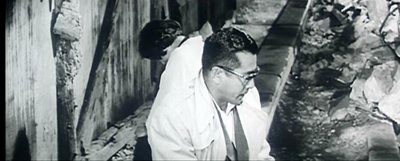
Kurosawa was a master at placing his actors in the widescreen tableau for effect, and this is a classic example. In the shot above where the two kiss, it’s just a stroke of genius that the wooden bench divides them, even as they share this tender moment. There is not a single second during this sequence where the two of them, husband and wife, are standing together.
Tuesday, September 19, 2006
"Poets of Filmlight"

Sven Nykvist, Stockholm, Sweden, 1995
copyright Piotr Jaxa - photo from the collection "Cinematographers - Poets of Filmlight"
Welcome to the first installment of a mini-series celebrating some of the world’s greatest cinematographers.
I was rooting around on the net a few weeks back when I discovered this website. It is with the kind permission of Piotr Jaxa that a few of his portraits will be presented here for your enjoyment. I have also included some selected stills highlighting the artistry of the men featured.
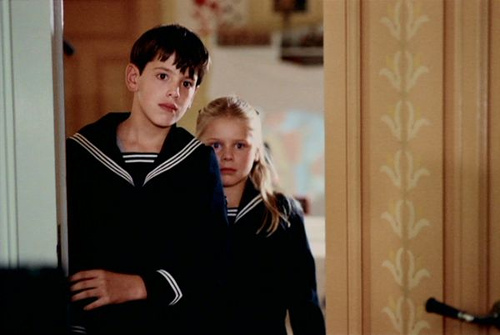 Fanny & Alexander, 1982
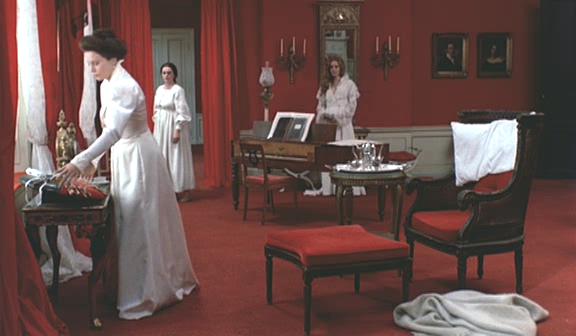 Cries and Whispers, 1972
 Winter Light, 1962
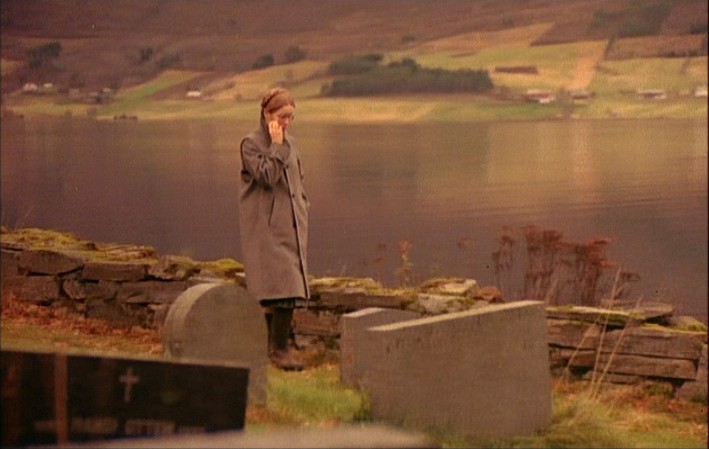 Autumn Sonata, 1978

Through a Glass Darkly, 1961
Sunday, September 17, 2006
And Also Starring...

Joe Pantoliono has always been always one of those character actor types that you remember. For Joe, it’s that weasely voice that burrows into you gray matter and stays there. He usually plays the type of character, that after you shake hands, you count your fingers.
To me, Joey Pants will always be Caesar from Bound. God, I love this movie. The whole plot is predicated on what Caesar will do after the two lesbian heroes set him up. They have stolen two million dollars of mob money, and Caesar is supposed to run away, because he will be the one to get blamed. Well, Caesar doesn’t do what he is supposed to. He tries to think and bluff his way out of the mess, and in true Hitchcockian fashion, we end up rooting for him. The plot, once it sets in motion, moves at whiplash speed. The guy has no time to think, but he does quite a job of it.
There’s a scene where Caesar kills 3 mobsters in his living room, has the cops in the room within five minutes, and manages to get away with it. How does he do this? Big, brass ones, my friend.
If you haven’t, check it out.
Friday, September 15, 2006
The Claim
Did you go to see The Claim when it was in theatres in 2000? Probably not, because very, very few people did. That's their loss, because this film is a flat-out masterpiece.
The setting is California in 1869, an era when the lure of gold had seized many. It's also an era where America was being opened up by rail, and the presence of the railroad could turn a little village into a boom town.
The film opens in the small town of Kingdom Come, and the arrival of 2 groups who will tear the fabric of the town apart. One of the groups is a group of railway surveyors, led by a young man named Dalglish (Wes Bentley). They are there to determine the route that the rail line will take. The other group is less conspicuous at first - A dying woman (Nastassia Kinski) and her young daughter Hope (Sarah Polley)
Very early on, the film makes reference to a Mister Dillon, and the implication is that he is a big wheel in town. Just how big is demonstrated when one miner is caught robbing another, and is sentenced to a public whipping. The charges are read to the onlooking crowd, and it's stated that the sentence is fifty lashes, but this is commuted to twenty-five by Dillon "Because he knows it will never happen again." Dillon himself carries out the punishment. This sequence alerts us that Kingdom Come is not a town like any other - That it is in fact owned and ruled by one man.
After the whipping has concluded, young Hope rushes up to Dillon and presses a rosary into his hand. Stunned, he blurts out "Hope?"..."Are you Hope?"
What's going on here? Well, we got a clue when the dying mother Elena pointed Dillon out to Hope from the hotel window prior to the whipping, but now we find Dillon going alone to an isolated old shack, and the film switches to a flashback sequence. We see a young couple with an infant struggling through a blizzard ,and coming upon a single shack in the snow. They are invited in, and discover that the occupant is a prospector, who has found gold but is desperately lonely. Fueled by too much alcohol, the young man makes a startling trade - His wife and child for the other man's claim.
If this plotline sounds familiar, it should. It's a re-working of Thomas Hardy's "The Mayor of Casterbridge", where a man named Michael Henchard sells his family to a sailor for 5 guineas. The Claim is at it's best when it stays with Dillon, who is played by a terrific, but little-known actor named Peter Mullan. Despite the ghastly secret he carries around, Dillon is essentially a good man, and when he is confronted by his past, he tries to make restitution for it. He brings a house for the two women to live in and arranges for medical treatments for the mother. He even remarries Elena. Dillon also has a couple of conversations with the mother, where he discovers that Hope doesn't know the truth about her past.
In the meantime, there is the issue of the railway, and a parallel plot follows Dalglish and his men as they survey the surroundings. Dillon, of course, fully expects the the railroad to go through Kingdom Come, and makes ominous statements to that end. It eventually becomes evident to Dalglish that thay will have to choose another route, and there is a small scene with a railroad executive where he basically says that there could be bloodshed when Dillon finds out. He is told to "Do whatever you have to" , and he silently agrees.
It has long been a pet peeve with me for films to give me one dimensional characters. That is, Character X is a bad guy...and that's all he is. In this film, things are a bit fuzzy. We already know about Dillon, but we start to look at Dalglish a bit differently now, as well. He and his men come back into town brandishing guns, and a confrontation seems unavoidable. It is to the film's credit that it doesn't degenerate into a big gunfight. People do die, yes, but the violence is sudden and minimal, and then things move past it.
The film now swings back to Dillon and the two women. Elena finally succumbs to her illness, and Dillon faces the prospect of losing his daughter once again. Up until this point, Hope has been lukewarm towards Dillon. She doesn't understand why her mother married this guy so hastily. Finally Dillon takes her to the small shack and shows her an old photo of the three of them. When she still doesn't get it, he asks her who is in the photo.
She replies: "It's you"
Mullan is simply marvelous here, as Dillon finally delivers the truth in his blunt Irish brogue.
"The baby is you. The woman is your mother"...."I sold you"......"I sold you both for gold"......"Right here in this hut."
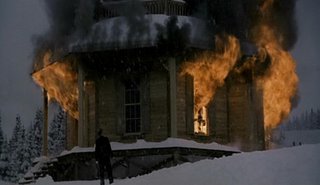
The final passenges of The Claim are simply put, beautiful. Dillon goes back to the town that he built up from nothing and torches the whole thing. The film lingers as the flames lick up and over the wood frame buildings and they eventually crash into soot. The same is true of the man. Dillon sold his family for a dream of wealth and achieved wealth beyond his wildest dreams. All of his riches turned to ash, however as Hope ran out of that little hut.
The cinematographer on the film is a man named Alwin Kuchler, and it would be criminal not to mention his name in a discussion of the film. The snowy outdoor sequences were filmed near Calgary, Alberta, and they are breathtaking.
Thursday, September 14, 2006


Sunday, September 10, 2006
On Location
 Jean-Pierre Melville (in white hat) at work on the great cops-and-robbers saga, Un Flic.
 Saturday, September 09, 2006
And Also Starring...

Stanley Kubrick’s The Killing is a film filled with pleasures, and one of the biggies is the twin supporting performances of Elisha Cook and Marie Windsor, as George and Sherry Peatty. This is a film couple like no other, and their combination of distain (her), and insecurity (him) starts the dominoes falling which will destroy the racetrack robbery caper that the film centers on.
Windsor’s Sherry is a bored housewife who seems to live in lingerie and has a stud on the side. She’s just biding time until she can blow the joint. George is another one of Cook’s nebbish types, who can’t really believe that this babe stays with him. They are marvelous in their screen time together, as she barely looks up from her magazine as he talks to her, and he is just chomping at the bit to tell her about his big score.
“Do you want me to call you Papa? Do you want to call me Mama?”
“It would make a difference, wouldn’t it? If I had money?”
Sherry twists him like a Gumby doll in this film, and sure enough, he ends up telling her more than he should.
“I’m gonna have money. Maybe hundreds of thousands of dollars.”
“Of course you are, darling. Did you put the right address on the letter before you sent it to the North Pole?”
And George basically spills the whole thing to her.
George gets cold feet at one point, but watch how easily she guides him back on course.
“Think of how disappointed I’d be if you didn’t get that money, George! I’d feel like you didn’t really love me."
Uh-Huh. He buys it, however.
Thursday, September 07, 2006
Monday, September 04, 2006
Moments of Distinction
The Film – L’Avventura, dir. Michelangelo Antonioni, 1960
The Set-Up – Sandro (Gabriele Ferzetti) and Claudia (Monica Vitti) have by now pretty well forgotten their quest for Sandro’s missing fiancée Anna. Sandro has just left their hotel and gone down to the courtyard. He notices a young man drawing. He’ll be back in a few seconds.

The artist has left his drawing unattended.

Sandro looks to see if the guy is watching.

He checks out the drawing again – a sketch of an architectural detail.

Sandro swings his keys and upsets the bottle of ink on the drawing, ruining it.

The young guy confronts Sandro. “You did it intentionally!” They jostle a bit.

Sandro pulls himself up and asks the young guy how old he is. Told that he is 23, Sandro relies “I was once 23, too. I was in so many fights, you couldn’t imagine.” Translation - “Your art is not worth fighting for.”

Antonioni has been gradually letting Sandro reveal himself to be spiritually and morally bankrupt, and it’s crystallized in this moment. Sandro is an architect who has long ago lost any passion that he ever felt for his art, and seeing this drawing, done just for fun, reminds him of how jaded and corrupt he is. That’s why he has to destroy it.
An aside: It will be interesting to see how often this feature reveals stuff that I didn’t notice before. Case in point – The guy who confronts Sandro is not the guy doing the drawing when he first sees it (1st frame). The actual artist appears to be the guy in the light jacket that breaks up the tussle.
Sunday, September 03, 2006
The Marquee (Eisenstein Division)
 Thanks to Squish at The Film Vituperatem for this image. Go have a look around his blog. You'll like.
Saturday, September 02, 2006
In a Year of 13 Moons
The story of In a Year of 13 Moons begins with another story – That of Armin Meier. Meier was an actor who appeared in several of the early films of Rainer Werner Fassbinder. He was also Fassbinder’s lover, and their breakup resulted in Meier’s suicide in 1978. Fassbinder reacted to this in the same way that he reacted to all the other turmoil in his life. – He made a movie. The resulting film is a searing personal statement of loss and loneliness.
The central character is Elvira, a lonely transsexual who is cruising for gay men when the film opens. A potential john makes the first advances, but when he discovers that it’s a woman he’s feeling up, he responds violently and calls a few buddies to assist. This establishes a pattern that we will see repeatedly throughout the film. Elvira tries to connect with someone, and everyone she approaches rejects her.
Take for instance, her lover Christoph. He shares her apartment, and when she returns home from the beating, he turns on her. When I first saw this film at Cinematheque Ontario a couple of years ago, I nearly walked out during this scene. That’s the level of the emotional cruelty that is directed at Elvira here. Incredibly, she absorbs it, and in fact apologizes and promises to do better.
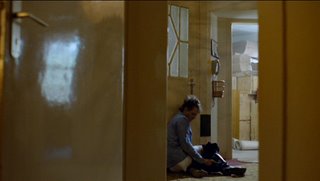
A kindly whore named Zora befriends Elvira, and she becomes her companion for the balance of the film. The presence of this second person gives Elvira a sounding board, and enables us to learn some of Elvira’s back-story. Elmira talks of her previous life as an abattoir worker named Erwin, and this leads to a grisly sequence in an actual slaughterhouse. As Elvira talks of her transformation and her life with the abusive Christoph, we watch cattle having their throats slit and their hides pulled off. This scene is a real gut-slammer, and it serves a couple of purposes. First, it mirrors the mutilation that Elvira herself has undergone – her quickie sex change. Additionally, it’s an effective metaphor for the world in which she resides. To the people around her, Elvira has about the same status as the cattle do to the slaughterhouse workers.
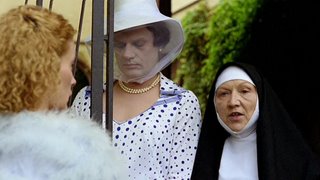
The centerpiece of the film is a visit by Elvira and Zora to the orphanage where Elvira grew up. They encounter Sister Gudrun, who remembers the young Erwin, and goes into a lengthy monologue about how Erwin was abandoned as a baby, how a young couple wanted to adopt him, and how his biological mother nixed the adoption rather that have the father know of Erwin’s existence. This scene is heartbreaking; as it indicates how close Erwin came to having a loving family, only to have it snatched away from him.
Why did Erwin become Elvira? That’s the question that the film revolves around, and early on, the name Anton Saitz comes into play. Saitz is a wealthy industrialist and concentration camp survivor who has some hidden connection to Elvira, which she has alluded to in a newspaper interview. Elvira sets out to track Saitz down, in order to persuade him from taking revenge on her, or worse yet, on her estranged daughter.
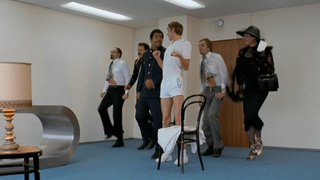
Elvira eventually makes her way to Saitz’ office tower, and if you watched this film, and were able to anticipate what the meeting would be like, you are a far better man than me. The first thing that is noticeable is how the office seems to be virtually deserted. Elvira encounters a security guard and when asked for the password, is able to dig it up out of her memory banks - “Bergen-Belsen”. The scene in Saitz’ office is bizarre, to say the least. When Elvira arrives, Saitz and his associates are re-enacting an absurd dance number from an old Jerry Lewis film.
Saitz is the one who finally fills out the blanks in Elvira’s past. Ervin was in love with Saitz once, and told him so. Saitz’ response was a flippant “That’s nice – Too bad you’re not a woman.”, and Erwin took it to heart and ran off to Casablanca for a sex change operation.
This astonishing lack of judgment is in fact consistent with what we have already seen with Elvira. She is desperate to connect with someone, whether it is her ex-wife or a john in a park. Time and time again in his films, Fassbinder gives us people who need love badly, don’t have a clue about how to get it, and are destroyed as a result of it. There’s the needy actress in Veronika Voss, the designer in The Bitter Tears of Petra Von Kant, or the lottery winner Fox in Fox and His Friends, just to name a few.
As I mentioned at the beginning, this movie is connected to the story of Armin Meier, and his relationship with Fassbinder. It’s no stretch to say that Meier informs the character of Elvira – Someone who loves the wrong people, and suffers because of it.
This might be the most personal and painful of the films Fassbinder made. Just how personal can be guessed at when you look at the credits. This is essentially a one-man film. Fassbinder wrote, produced, directed, shot and edited 13 Moons. It almost seems like this film was his penance, and he had to suffer it alone.
Tuesday, August 29, 2006

Sunday, August 27, 2006
Moments of Distinction
Welcome to the birth of a new feature here at filmscreed. I will periodically take a movie moment that I love and try to explain to you just why it resonates with me so much. There will be no rhyme or reason to my selections – It’s just stuff I like.
And so, with no further ado….
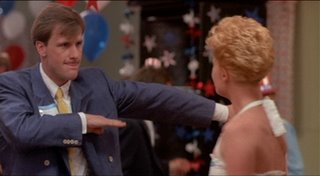
The Film – Something Wild, dir. Jonathan Demme, 1986
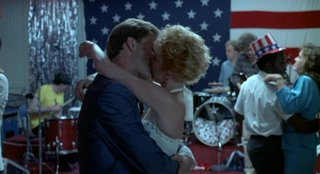
The Set Up – Kooky Audrey (Melanie Griffith) has kidnapped uptight Charlie (Jeff Daniels) and taken him to her high school reunion. Charlie starts to relax and begins to have feelings for her. This moment starts during the dance, and the Feelies funky version of “Fame”. Charlie shows off his moves.
The walls are down. They kiss. The lights go down and the music changes to a slightly ominous guitar.
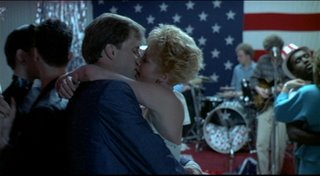
Note the black leather jacket on the left.
“Hi, baby. Surprised?”
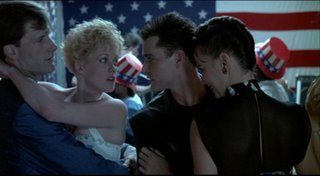
This is our first glimpse of Ray Liotta as Audrey’s husband Ray, and it is without any doubt my favorite movie entrance. The guy says three words, and the whole tone of the movie changes in that instant. Up till then, it has just been a screwy little romantic comedy. When Ray arrives on the scene, we know as soon as he opens his mouth that he’s trouble.
How many times have you seen the movies give us the girl with the louse in her life? Do you always wonder why she was with the guy in the first place? I do. Here, though, I don’t because Liotta gives Ray a very strong sexual magnetism along with the menace. You have to begrudgingly admit that a girl could fall for him.
Saturday, August 26, 2006
On this Date
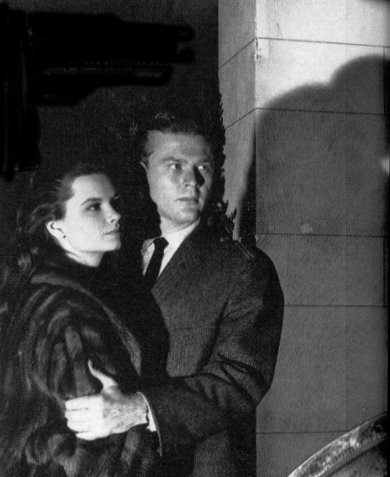
This one is a cheat – I’ll freely admit to that.
On this date in 1938, Susan Harrison was born. She was a fringe actress with only a handful of credits to her name. So why is she being featured here? Well, it’s like this – One of her roles was as Susan Hunsecker in Sweet Smell of Success, which is one of the coolest, smartest, and nastiest flicks ever to come down the turnpike.
Without intending to, I have been finding myself watching films written by Clifford Odets lately. The past couple of weeks have had me watching both Clash By Night and The Big Knife. An Odets script identifies itself quickly. His characters are quick on their feet, and they give you the impression that they’re gone out and lived a bit. A Odets character will be asked about women and reply “There’s room in the world for em”. Neat, huh?
This post is nominally about Susan Harrison, but in reality, it’s just an excuse to savor the dialogue in SSoS, the Big Daddy of all Odets screenplays.
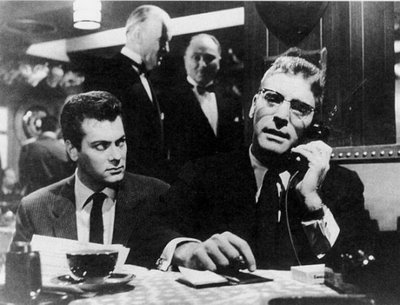
“I don’t relish shooting a mosquito with an elephant gun – Why don’t you shuffle along?”
“You’re dead, son. Get yourself buried.”
“The cat’s in the bag, and the bag’s in the river”
“From now on, the best of everything is good enough for me.”
Friday, August 25, 2006

Thursday, August 24, 2006
And Also Starring...
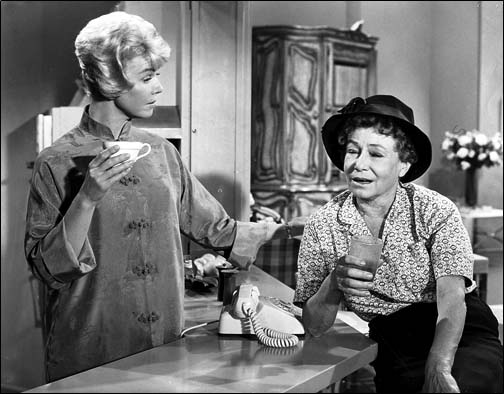 Doris Day and Thelma Ritter in Pillow Talk.
If one were to sit down and write about Thelma Ritter, it is inevitable that Rear Window would come up. Fair enough. It’s her most memorable part, and the role of Stella is vital to the film, although many people might not notice why.
You see, as the housekeeper/nurse to James Stewart’s voyeuristic photog, she’s the conscience – the voice in the background telling him that he should have better things to do than watch other people’s affairs. Everyone remembers the great Ritter line;
“People should go outside and look in at their own lives”
That’s the thing about the characters that she played. They were usually world-wise, and the people around her would have done well to listen up.
In Sam Fuller’s Pickup on South Street, her low-life informant Moe is the one who points Richard Widmark’s Skip towards the woman who could be his salvation. Ritter got one of her half-dozen Oscar nominations for this performance, and it’s her best. When you watch her quiet resignation as she prepares to die at the hands of the Commie villain, you see an entire lifetime of disappointment and sadness coalesce in a few moments. It’s film acting at its finest.
Then there are comic roles, such as Doris Days’ perpetually hung-over maid in Pillow Talk. She is underused in this one, but she makes the most of the screen time she does get. One of the funniest bits in the film is her drinking Rock Hudson under the table, and sure enough, giving him the correct romantic advice.

Thursday, August 17, 2006


Sunday, August 13, 2006

Subscribe to:
Posts (Atom)