
Anna Karina

Bonjour Tristesse – Otto Preminger number from 1958 about an irresponsible playboy (David Niven), his carefree daughter (Jean Seberg), and the mature woman who disrupts their lives, with tragic consequences (Deborah Kerr). This is supposed to be a statement on the shallow, frivolous lives of the idle rich, but a good deal of it is pretty flat and uninspired. I never really felt like I was watching real people. There is stuff to like here – There is some amazing location photography in the French Riviera, and Seberg is sexy as hell, playing younger than her actual 20 years. A marginal recommendation.

Nada – Claude Chabrol made this jet-black satire on revolutionary politics in 1974, and truth be told, it’s not his best work. It involves a small band of Marxists and their plot to kidnap an American politician. Chabrol gets the kidnapping out of the way fairly quickly, and then gets down to his real agenda, which is the endgame between the various forces on the side of the law, who all want their own results from the crisis. The government is not completely opposed to the idea of the politician being killed, because that would allow them to come down hard on the country’s leftists. It’s an interesting idea, but is so sour that it eventually stretches the limits of credulity.


Office Space– This film is the whimsical cousin of the Up in the Air in that it skewers the cold, uncaring world of big business. Ron Livingston plays an office drone who accidentally gets hypnotized and ends up not caring about work…And ends up getting promoted for it. This film is a bit of a muddle, with a few hits and a few misses. My main problem is that the corporate types are such overblown straw man types that it took me out of the movie. The highlight for me is Stephen Root as the beleaguered Milton, who finds himself banished to the basement and has to fight to retain his beloved red Swingline stapler.


Innocents with Dirty Hands – Claude Chabrols’ 1975 take on Double Indemnity, with Rod Steiger as the cuckolded husband and Romy Schneider as his unfaithful wife. This one is very well done, with a couple of major twists in plot. Perhaps one too many. Chabrol being Chabrol, IwDH is a pretty sexy little piece of work. If you are a red-blooded male type, I defy you to watch Schneiders’ first two minutes in this film, and not feel a major fire in your loins.

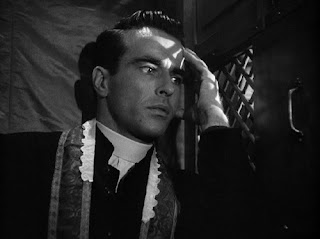
I Confess – My first viewing of this lesser-known Hitchcock. Montgomery Clift plays a priest who hears a murderer’s confession, then finds himself accused of the murder. Clift is a bit wooden in this film, and the circumstantial evidence that leads to his accusal is contrived, but I recommend it anyway. It’s a great rendering of the common Hitchcockian theme of the man falsely accused. In this case, the actual murderer doesn’t seem to harbour much guilt, but his wife certainly does, and the film builds some good tension around her. Karl Malden stars as the investigating detective. An added note is that the film is set in Quebec City, and contains some great visuals of that beautiful town.


Is Paris Burning? – Rene Clements’ 1966 retelling of the French Underground and the liberation of Paris in WW2. The pros: Some amazing location shooting and a terrific performance by Gert Frobe as a German officer charged with an impossible task – Defending the city against the unstoppable Allied tide. The cons: Unlike Hoops Dreams, this movie is 3 hours long, and SEEMS like it. Also, it’s jammed with high profile cameos, and they tend to distract. Oh, look! Kirk Douglas! Hey, Simone Signoret! Still, I recommend this one.

The Baron of Arizona – I guess I was expecting this Samuel Fuller work from 1950 to be more or less a standard Western. It has elements of that, but it’s also a bio and a Noir Western (It was photographed by the great James Wong Howe). Vincent Price plays James Reavis, who tries and almost succeeds in carrying out a swindle that would net him the whole state of Arizona. This is loosely based on a true story. It’s somewhat interesting and I give it lukewarm recommendation.

Right from the start, there’s something a little off kilter about Collie (Jason Patric). He’s scruffy and unkempt, yes, but it’s something beyond that. It’s the shuffly way he walks, and the way his clutches his paper bag full of personal belongings. Most of all, it’s just the look in his eyes, like he’s focusing on something that no one else can see. In a voice-over that opens the film, he essentially lays it out for us – “I wonder if I should go back. They weren’t really doing me much good there, anyway.” The “they” plainly means an insane asylum.

When Collie wanders into a small bar for a beer, his behavior is jittery and annoying, and he is very clearly getting under the skin of the bartender. When Fay (Rachel Ward) wanders in, the movie spikes immediately. Fay is an alcoholic – That much is plain very quickly, but she also has a smoky, “Throw me down on the linoleum” sensuality to her. She seems like a woman who knows that men desire her and is not adverse to using this knowledge if it would benefit her. In this case, she takes Collie home, and puts him to work doing yard work for her.
This relationship is fascinating for the way that the film lets the sexual tension simmer away between the two of them. When Collie asks her about where her husband is, she replies “He’s dead – Gone to Hell” What the hell is up with that line? Another snippet of dialogue that makes you take notice is when she reacts to a peculiar stare with “Don’t get any ideas, Collie – We just met.” If you are trying to dissuade a man’s lust, that one doesn’t quite do it, does it?


The dynamic between Fay and Collie, is vital to the later events, but the film doesn’t really kick into gear until we meet Uncle Bud, played by Bruce Dern. He is a former cop and is one of those Film Noir characters that have a little something on the go. He wastes no time in starting to work on Collie, in that slimy Dern way. We’ve already had a hint of what Bud’s “deal” is, from some newspaper clippings left out at Fay’s place. The plan is to kidnap the child of a wealthy family for a ransom, with Collie being the one who takes the child.

It’s not a criticism of ADMS, but rather merely an observation that the details and motivations behind the kidnapping are not really important to the film. We learn that Uncle Bud has some debts that are starting to threaten his future well being, but what about his partner Fay? It’s hard to pin down her role in the crime. There’s no indication that there is anything between her and Bud. The monetary aspect is more likely, but is not really spelled out, either. Look at the home she lives in – it is an expensive home, but it is in disrepair. The late husband appears to have been well off, so is she going along with the scheme to maintain an affluent way of life that she can’t maintain any longer? We never really know. She even tries to warn Collie away from Uncle Bud at one point.
I haven’t mentioned the role of Doc Goldman (George Dickerson), who meets Collie in a restaurant, and quickly sizes up what is going on with him. In truth, this character could have possibly been omitted from the film. He is notable in that in his meetings with Collie, he tries to push him away from getting involved an anything destructive. He’s a kind of Jiminy Cricket character. The other thing is that this man is almost certainly homosexual, and is attracted to Collie.

I can’t say enough about the performance of Jason Patric in this movie. It’s hard enough to portray mental illness, and he does that remarkably well, but here he has a character that, despite his sickness, is slyly intelligent. He suggests an alternative to the ransom – Someone will rescue the kid and get a reward. He goes along with Uncle Bud’s plan, but is smart enough to know that Bud is going use his own idea to double cross him.
There are brief flashbacks during the film to Collies boxing career, and as the story progresses they eventually culminate in the event that led to his breakdown – He loses it in the ring and brutally beats another fighter to death. In addition to explaining why Collie ended up in an asylum, this information also points up something else – something that was a cornerstone of Film Noir – the need for a character to atone for part misdeeds.

The kidnapping goes as planned, but now Collie steps away from his nut-job façade and starts to take the lead. The child, it turns out, is diabetic, and will die unless he gets insulin. It’s Collie who protects the kid when Bud wants to get rid of him, and it’s he who gets the insulin and nurses him back. Patric is truly brilliant in these scenes, as he alternates between cold toughness with Fay and Uncle Bud, and tenderness with this frightened child.
When you read commentaries on many of the landmark Noirs, there’s a word that comes up often. That word is inevitability. The protagonists’ destruction is the only way for the scales to be balanced. Well, that concept has rarely been dealt with in a more sublimely perfect way than right here. Collie knows that the child has to be returned to his parents, and he knows that there is one way for Faye to escape. He has a great monologue which sets this plan into motion, while at the same time making us re-consider what we think we already know about him. And, inevitably, he gets the outcome that he needs.
The Whole Shootin’ Match – This 1978 indie offering was unknown to me, but it’s a real little gem. Lloyd and Frank are a couple of losers who steadfastly believe that riches are right around the corner. The film has some laugh-out-loud moments: “Chinchillas! Remember that one? I should be driving a chinchilla Cadillac by now!” But it is also touchingly realistic and carries with it a sad sense of inevitability. It reminded me an awful lot of the great Canadian film Goin’ Down the Road. They’d make great double feature. Recommended.
 The Steel Helmet – Sam Fuller’s 1952 Korean War flick, with Gene Evans as the hard-as-nails Sgt. Zack. This is not a great film, but it’s pretty good, and as you would expect from Fuller, completely devoid of false notes. Evans is a gruff loner who finds himself absorbed into a ragtag outfit, which includes such types as the green commanding officer, and a brave Japanese-American. There’s also a young Korean sidekick who goes by the nickname “Short Round”, and yes, Steven Spielberg borrowed this name for a similar character in the second Indiana Jones movie.

Man with the Movie Camera – This silent Russian film from 1929 is about the nuts and bolts of creating moving pictures, and if you’re a film lover, you should see it. There’s no plot, no characters, just images – and images of those images being created. And images of the editing process, with still frames that come to life later in the film. It’s a groundbreaking film, and in it you can see the seeds of modern-style whiplash shooting techniques. Recommended.


In a Lonely Place – I started out hating the smug cleverness of in this Nicholas Ray offering, but it won me over. I assumed that Humphrey Bogarts’ damaged screenwriter Dixon Steele would reform himself, and presto, everything would be glorious. The turning point came when a minor car accident escalates, and Steele picks up a rock with the intention of finishing the other guy off. At that point I thought, “Whoa, this movie is serious!” Bogie is marvelous in the films’ second half, as he realizes that the woman he loves is drifting away from him.




_01.jpg)


_01.jpg)


