Saturday, July 08, 2006

Wednesday, July 05, 2006
On This Date
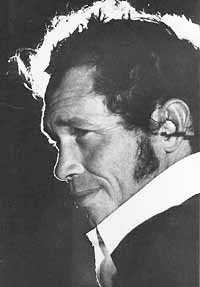
Take a moment to pour yourself a drink – Tequila would be best – and join me in a toast to the late, great, Warren Oates. Warren would have turned 78 today, and they aren’t making his type anymore.
When he was finished with the Marine Corps, Warren decided to try his hand at acting. This was in the 50’s and the golden age of TV Westerns, and Warren found his niche playing heavies on various series.
At the same time, Sam Peckinpah was honing his skills on such series as "The Rifleman", "The Westerner", and "Trackdown", and he and the fledging actor struck up a friendship. Peckinpah eventually moved to the big screen and when he made his early masterpiece "Ride The High Country", Oates was with him as one of the white trash Hammond brothers.
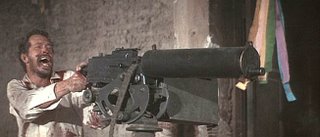
In the amalgam of beautiful moments that are "The Wild Bunch", my favorite belongs to Warren. When William Holden’s Pike comes to collect him to go and get Angel, their conversation is a marvel of economy. Pike says simply "Let’s go!" and Warren gives this wry little smile and replies "Why not?" Damn right.
My personal favorite Oates role, however, isn’t with Peckinpah – It’s in Monte Hellman’s "Two-Lane Blacktop". Driving a cool yellow GTO, Warren steals the film out from under its boring-as-sawdust headliners, James Taylor and Dennis Wilson. As a lonesome hot-rodding knight errant, he’s the one whiff of real humanity in the film.
So here’s to you, Lyle Gorch.
Here’s a little something for the piano player.
Thursday, June 29, 2006

Tuesday, June 27, 2006
Tuesday, June 13, 2006
Monsieur Klein
The title hero of Joseph Losey’s 1976 film “Monsieur Klein’ is a wealthy Parisian art dealer who seems to not have a care in the world. The greatest horror of the twentieth century is occurring all around him, and while he’s not oblivious, it means no more to him than the opportunity to make money.
The thing is, although the film revolves around the Holocaust, it never really talks about it. Hitler is never mentioned, and German soldiers are seen only very briefly. In the film’s opening sequence, a naked and obviously frightened woman is undergoing a humiliating physical exam. The doctor spends a lot of time examining her face, and finally comes to the conclusion that the woman shares some common features with the “Semite” race. This is masterful, as it quietly establishes that the Jews are starting to be rounded up – with the co-operation of the French.
Mr. Klein (Alain Delon) is first introduced to us off-camera as a gentleman comes to his door to sell a painting. Again, Losey feeds us information in an indirect way, as we listen to the conversation. It’s pretty easy to gather that the man is Jewish, and needs raise some money quickly. Klein knows this, and coldly lowballs the man on price. On his way out, the man says derisively that Klein is taking advantage of people, and Klein retorts that “Sometimes, I don’t even want to buy.”
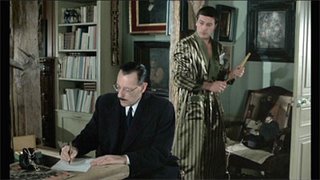
A pivotal moment ends this small exchange, as Klein sees a small Jewish newspaper on his doorstep, and tells the man that he’s dropped it. The man reaches into his jacket and pulls out his own copy.
Klein makes a trip to the offices of the magazine to try to stop delivery to his address, and this is again a beautifully done example of how we are given information by characters who-tap dance around what they really want to say. Watch Delon’s face when he is told that the magazine’s subscription list is in the hands of the Prefecture of Police. This is the first small crack we see in Klein’s cool façade. There’s also a terrific little exchange as the magazine manager tells Klein that someone may have given him a gift subscription.
“No one would play such a joke on me”
“Do you think we are the subject of jokes?”
The trip to the magazine tells him, however, that there is another man with the same name, and a visit to the man’s address turns up an abandoned apartment and a blurry photograph of the other Klein on a motorcycle.

One day, a love letter arrives that is intended for the other Klein, and it leads Delon to a rich family on the country who are confidantes of the other Klein. As Klein is led into the house, we see that some of their paintings have been taken down off the wall. This isn’t pursued, but it raises the possibility that Klein may have profited from some of their artwork, as well. It also suggests that the other Klein is Jewish. The woman of the house (Jeanne Moreau) comes to Klein at night to retrieve her letter – She is having an affair with the other Klein, and in fact goes out in the middle of the night to meet a man on a motorcycle.
The French police ask for birth certificates of Klein’s grandparents, and he sends his lawyer Pierre for them. At this point in the proceedings, he might be well advised to get out of town, but he is obsessed with finding the other man, and gives the impression that he doesn’t really believe that anything bad is going to happen to him.
The adjective Kafka-esque is often used to describe this film, and it’s an apt description. The French police are investigating Klein, and the other Klein is using him as a decoy. The man on the motorcycle is likely the other Klein, and there’s another instance where Delon is in the same bar with his man, and misses him. He never does actually see the guy. A search for a woman in the photo is maddening; as he is told her name is Isabelle, then Cathy, and then finally, Francoise.
Finally, he comes to the conclusion that he has to get away, and there is a delicious irony in a scene where his lawyer asks about the value of his stuff.
“About 10 million”
“How about 7 or 8?”
When the opening credits roll on this film, they are over a painting – A painting of a vulture pierced by an arrow. This same painting is sold at an auction later in the film, with Klein in attendance. We wonder if he senses the parallels to his own life. He has made money off desperate Jews, and in so doing, given them the means to escape. When his time comes, after he has been rounded up and loaded on a train bound for Germany, we again hear his narration from the opening meeting with the old Jewish gentleman selling his painting. Then the doors slide shut, and the vulture is carried away.
Friday, June 09, 2006
Between the Covers

Fraser’s account of the British campaign in Burma is a vividly remembered time capsule, and also a sobering reminder of the mind-set men shift into when they are asked to kill other men. Just nineteen years old when the book’s events occur, Fraser details the daily lives of his beloved Nine Section (The "Black Cats"), both in the swirl of fierce and bloody battle, and the quiet down moments.
Modern readers may be put off by Fraser’s seemingly casual racism towards the Japanese. He admits to it, and is refreshingly honest about its roots. His thoughts on the bombs dropped on Hiroshima and Nagasaki are telling – He is stridently unapologetic, yet can also write, "If it was not barbaric, then the word has no meaning."
The opening lines:
"The first time I smelt Jap was in a deep dry-river bed in the Dry Belt, somewhere near Meiktila. I can no more describe the smell than I could describe a colour, but it was heavy and pungent and compounded of stale cooked rice and sweat and human waste and ….Jap. Quite unlike the clean acrid wood-smoke of an Indian village or the rather exotic and faintly decayed odour of the bashas in which the Burmese lived – and certainly nothing like the cooking smells of the Baluch hillmen and Gurkhas of our brigade, or our own British aromas. It was outside my experience of Oriental stenches – so how could I know it was a Jap? Because we were deep inside enemy-held territory, and who else would have dug the three bunkers facing me in the high bank, as I stood, felling extremely lonely, with a gallon tin of fruit balanced precariously on one shoulder and my rifle at the trail in my other hand."
Monday, June 05, 2006
Pierrot Le Fou
"It’s possible to hate half or two-thirds of what Godard does – or find it incomprehensible – and still be shattered by his brilliance."
Pauline Kael
Sitting down to dissect a Godard film is like trying to pick fly shit out of pepper with boxing gloves on.
Me
Seriously, when you start becoming a cinephile, you will run into Jean-Luc Godard pretty early on. He was one of the vanguards of the French New Wave, and his influence is immeasurable. He is, however, a tough nut to crack. He takes all your preconceived notions of what a movie should be, and tosses them out the window. I’ve seen most of the stuff from his great early period, and I’m mixed – There are films I like a lot – "Band of Outsiders", "Week-End", "My Life to Live", and " Les Carabiniers" - and ones I’m lukewarm to, like "Alphaville", and "Masculin-Feminin". The one that I keep going back to, however, is "Pierrot Le Fou", from 1966. Of all his stuff, I think this one is the most fun, and was made with the lightest touch.
The film opens with Jean-Paul Belmondo’s unemployed TV exec Ferdinand getting ready to go out to a party with his wife. On the way out, he meets a baby-sitter (Anna Karina) hired by his wife, and there is a small, yet noticeable recognition as they shake hands. More on that later. The party is Godard at his best. These people bore Ferdinand, and as he moves around the room, Godard has the characters talking in TV commercial blurps instead of conversational dialogue.
"The new Alfa-Romeo with its 4-wheel disc brakes"
"I use Odorono after my bath for all-day protection"
Ferdinand leaves, and goes home to find Marianne the sitter sleeping in a chair. He offers to drive her home, and here it’s revealed that the two have been in a relationship. The talk in the car, first with the camera on her as he speaks, then on him as she does, and they basically just run away together.
"It’s in this extended road trip that "PLF" really takes wing. The two wake up at her place, and as they talk, the camera pans past a dead body on a bed, and several machine guns laying about the place. These things aren’t remarked upon, but as they leave the narration goes into a fragmented call-and-respond mode between Ferdinand and Marianne. "This is a story" "All mixed up",etc. From these bits, we start to get an insight into Marianne. She has a brother Paul who is a gunrunner, and she is in some kind of trouble.
As the couple travels into southern France, the film starts to give the sense of being a story being invented, rather than a narrative of events. At one point Belmondo turns and talks directly to the camera. Karina asks him whom he is talking to, and he replies "The audience". Then there is the matter of his name. Marianne always calls him Pierrot, and he, without fail, responds "My name is Ferdinand." In several cases, the characters use the logic of movies, at one point Marianne even says "I saw this in Laurel and Hardy". There are references to "Johnny Guitar" and "Pepe Le Moko", and Sam Fuller even appears as himself at one point.
Godard could usually be counted on to include some kind of political diatribe in his films, which would often have the effect of grinding them to a halt. Think of the garbage men in "Week-End" or the blond firing squad victim in "Les Carabiniers". Here we get the Viet Nam war played as a short moneymaking skit by Ferdinand and Marianne for the benefit of some American servicemen. In this case, it works OK.
Marianne’s troubles eventually catch up to her. Ferdinand is surprised by a couple of hoods looking for her, and they resort to the most unusual mode of torture this side of Monty Python. Ferdinand is put in the bathtub, and they spray water in his face. It seems that Marianne has killed one of their colleagues (The guy on the bed!), and stolen money from them. He tells them where to find her.
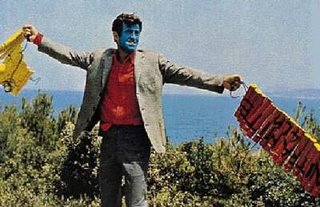 The concept of watching something that is just an artifice is brought home as we meet Paul, and realize that he’s not her brother at all, and that poor Ferdinand is just a rube. He gets his revenge in a finale that is arguably Godard’s best. Certainly, the most memorable image in "PLF" is of the deranged Ferdinand, face painted blue, waving dynamite in the air. He has decided to go out, literally, with a bang, and even lights the fuse. It’s somehow fitting that he changes his mind too late, as it burns down to nothing.
The Marquee (Brass Knuckle Division)
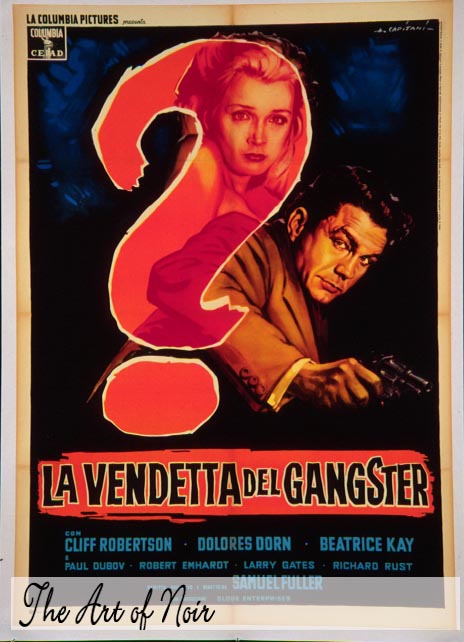 aka "Underworld U.S.A." - Sam Fuller, 1961
 A future commentary?
Sunday, May 28, 2006
Saturday, May 27, 2006
Between the Covers
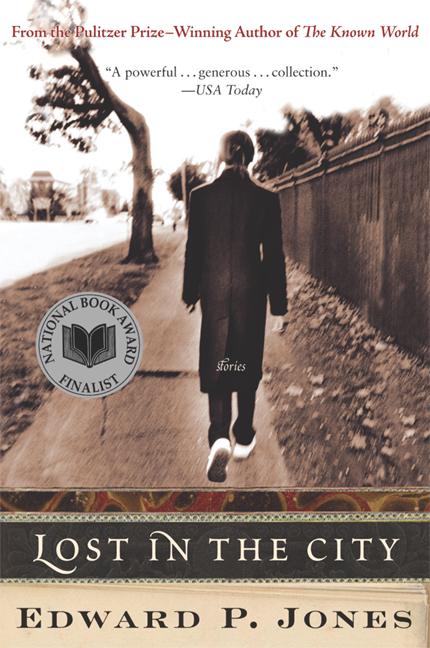
Washington, D.C. is home for the souls who populate Edward P. Jones’ "Lost in the City". It’s a terrific collection of fifteen short stories, and Jones paints his people with quick, powerful strokes. There’s the sharp, mouthy Cassandra with her stolen car in "The Night Rhonda Ferguson was Killed". There’s Caesar, the young hood who is at the center of "Young Lions." And there’s Horace, the vain widower who lets his life careen out of control in "A Rich Man."
The stories all revolve around black families in D.C., and many of them are set in the fifties and early sixties. These are not necessarily harsh stories of big city life, although that reality is always simmering in the background. Jones weaves a story out of something as simple as a child’s first day of school ("The First Day") or a chance meeting with a dreadlocked man at the subway station ("An Orange Line Train to Ballston")
"One night, all of us - me, Lonney and his mother and Brenda and her parents – were sitting arouind his living room, talking about the wedding and everything. Someone knocked on the door and Lonney opened it. It was his old man, standing right there tall and straight as a lamppost in his uniform. You know something’s wrong when a man doesn’t even have a key to his own house."
From "The Store"
A nod to Lance Mannion, who made me want to read this.
Thursday, May 25, 2006
Cyclo
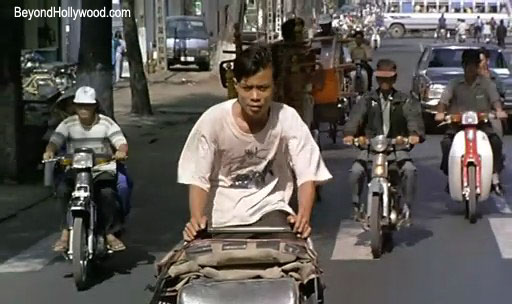 The Cyclo boy is young – he looks like a kid who might deliver your paper. You watch him for a while, and it occurs to you that while he’s just a kid, he isn’t youthful. There’s not even a hint of carefree childishness or immaturity.
This starts to make sense when we meet the rest of his family. He lives with his elderly grandfather who goes out every day and repairs bicycle tires, even thought his health is failing. There’s an older sister who carries pails of water to restaurants for a living. And there’s a young sister of not more that 7 or 8 who has her own full-time job shining shoes.
"Cyclo" is set in Ho Chi Min City, Viet Nam, and it is the story of the Cyclo boy and his sister and how poverty forces them into crime and degradation.
The opening shot in the film is a head-on shot of the Cyclo boy at work. A "cyclo" is a bicycle taxi, and the boy is following in the footsteps of his father, who also drove one, and was killed by a car. The film is light on narration – we just watch him work, and this accomplishes two things – First, we see how difficult the job is, and second, we get a sense of the city he lives in.
Ah, yes, the city. Very seldom has a city looked grungier and more inhospitable than here. There’s a scene early on where the cyclo boy is threatened by others for working on their turf. His boss, who is known only as "The Madam" warns him that other gangs are protective of their areas.
One day, while stopping to have a leak, his cyclo is stolen, and in trying to get it back he gets beaten up. He reports this back to the Madam, and to enable him to pay for the cycle, he is put under the direction of a gang leader known as "The Poet." His indoctrination into gang life is a harsh one. One day the rest of the gang takes him to watch the handiwork of a man known only as Mr. Lullaby. Mr. Lullaby has some poor unfortunate soul tied to a chair with his face covered in clear tape, and after a bit of banter, slits the man’s throat. The Cyclo boy is sickened by this, but the killer makes him a gift of his switchblade, and the Cyclo boy lays in bed with it that night, touching his face with the knife in a strange fetishist manner.
The older sister, meanwhile, has also drifted into the orbit of the Poet. She becomes a whore, and her encounters with clients are perverse, and again, deeply fetishist. One man forces her to drink water, so he can watch her pee. Another has a foot fetish, and has her put on nylons, which he proceeds to cut off with scissors.
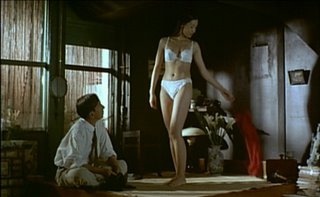
One day the Cyclo boy sees one of the toughs who stole his bike, and tells the rest of the gang. The response surprises him - "He works for the Madam, too" This is never really explored, but it raises the possibility that the bike was stolen just to get a young recruit into the illegal portion of the business.
One night the sister is taken to a fancy disco, and hired out to a wealthy yuppie. The following day, she is beaten and bloody, and one of the other whores sceams at the shaken Poet.
"You bastard! She was a virgin!"
The film cuts directly the roof of a building, where the Poet murders the violent john in a long and relentlessly bloody scene.
The Poet is the enigma of this film. There have been indications that he loves the sister, and the murder would seem to reinforce that, but it’s hard to tell. Like everyone else in the film, the Poet says very little. In any case, it’s safe to say that the rape and murder affect him deeply, because he goes home and torches his place with him still in it.
There is a recurring image of things covered with paint in this film. The Madam has a retarded son who covers him self in yellow paint. The Poet gets nosebleeds, and at one point drops of his blood fall on a white flower. The Cyclo boy tries to calm himself with pills and booze before doing a job, and instead ends up covering himself with blue paint as across the street, the Poets’ apartment goes up in flames.
"Cyclo" is peculiar and difficult film. As I mentioned above, dialogue is scarce, and we are not allowed to get too close to the characters. Cyclo boy, his sister, and the Poet live in a world where life starts out tough, and sometimes gets worse. There is an astounding shot toward the end of the film, where the camera pans over tennis courts, and a swimming pool filled with affluent types, before moving down to the street and picking up the Cyclo boy and his family on a new cycle taxi. The narration tells a story about how the family’s cat came back, and there’s an obvious parallel to the family, which went through a harrowing ordeal and managed to come out the other side. They know the truth, and they would likely tell those people playing tennis – yeah, I’ve been to Hell – It’s just around the corner.
Saturday, May 20, 2006
Wednesday, May 17, 2006
Goin' Down the Road
Were you to swing a dead cat in downtown Toronto, you’d hit someone from somewhere else in Canada. The hoser version of "The Grapes of Wrath" has been going on for decades, with rural Canadians seeking a better life in the Dominions’ largest city. That’s especially been true of Atlantic Canada, where the long-term decline of the fishing industry has made things tough.
The main characters in Donald Shebib’s 1970 landmark "Goin’ Down the Road" are such people. Peter McGraw and Joey Mayle are packing their car when we first meet them, and they don’t have any doubt in their minds – They’re going to conquer Toronto. They have that youthful piss-and-vinegar- I’m bulletproof aura, and as they drive, they let us in on their plans. They have a place to live lined up with a distant aunt, and jobs waiting for them courtesy of a fellow Nova Scotian.
Their plans hit a couple of snags early on. At the aunt’s house the occupants don’t even open the door, and watch the strange newcomers from behind the drapes. It’s obvious that nobody told THEM they would be having houseguests. Then, a phone call about their jobs comes up dry as well. The first night in Toronto is spent at the Salvation Army. It’s here that some doubt starts to set in, as Joey remarks "Maybe we should go back home, Pete." Pete is having none of that, and shows him a classified page with dozens of jobs. He remarks "I’d like to work in an office. I’d have a secretary…my name on the door."
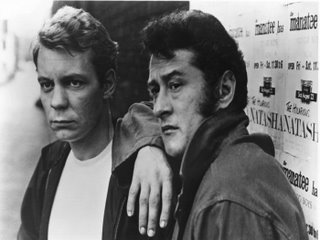
The following day marks the beginning of their job search, and we follow Pete as he goes to an interview at an advertising agency. A condescending executive questions Pete and we feel as awkward as he does. The exec remarks "What made you want to apply here?" Joey is more realistic, and at the end of the day, he informs Pete that he has gotten a job loading cases of pop, and that Pete should go and apply, too.
The boys now have jobs, and watching them work, we think that this isn’t likely much better than what they’ve left behind. Pete certainly doesn’t think so, either, and says as much.
Pete also decides that he has an eye for the sexy Nicole, who comes in a couple of days a week. The other guys in the plant lust for her, but all think she’s unattainable. Pete manages to wangle a date with her, but the date consists of her dancing with her friends, and him sitting alone drinking in the corner. After dropping her off at home, Pete sees the rest of the guys spying from the parking lot, and hides in the entrance of the building rather than have them know he hasn’t slept with her.
Meanwhile, Joey has fallen in love with a waitress named Betty, and things move pretty quickly. He reveals to Pete that she is pregnant and that he is going to marry her.
We see Pete visiting the couple at their new apartment, and he remarks on all the new stuff they have. Joey proudly tells of the great deal he got, and that he doesn’t have to pay a cent until months later. This recklessness makes us cringe, and predictably enough, the two get laid off at the plant. Sinking into poverty, Joey and Betty (and Pete) move into a run-down apartment, and do whatever they can to survive - Washing cars, setting pins at a bowling alley, delivering newspapers.
There’s a terrific sequence where we watch the boys delivering newspapers. They eventually just say he hell with it, throw the papers away, and engage in a snowball fight, while Bruce Cockburn sings on the soundtrack:
"Just where do you belong, I’d like to know?"
As if in response, the film shows them quietly watching a ship on Lake Ontario at the end of the sequence.
There is a sad inevitability to the story, and we eventually find Pete and Joey at a supermarket filling a cart with groceries. They have a pathetic plan to steal the food, and an encounter with a perceptive clerk ends in violence. With no money, no prospects, the police now looking for them, a baby on the way, the boys come at a crossroads.
I will not spoil the finale for you, except to say that it is remarkable in its’ sadness and beauty. If you go back to the start of the film, Peter was the enthusiastic one, and Joey had his doubts. At the end of the film, we realize that the roles have reversed. Peter is pretty happy with their solution, but not Joey. Joey won’t be happy for a long time to come.
Saturday, May 13, 2006
Tuesday, May 09, 2006
Sullivan's Travels
I just realized that I’ve not yet written about a comedy. To remedy this, I’ve decided to look at one the giants of Hollywood – Preston Sturges. That name wouldn’t ring a bell to most modern filmgoers, but during WW2, everything he touched turned to gold. I considered doing "The Great McGinty" from 1940, with Brain Donlevy as a mob leg-breaker who develops a social conscience, or perhaps the divorce-for-profit farce "The Palm Beach Story" from 1942. Both these films are gems, but neither is my favorite Sturges. That would be "Sullivan’s Travels", from 1941.
The Sullivan is John L Sullivan (Joel McRae), successful Hollywood film director. As the film opens, Sullivan is trying to pitch his new picture "Brother, Where Art Thou" to two studio types. They are skeptical, because Sullivan’s stock in trade is the light romantic comedy, and the new movie is supposed to be a serious social drama.
"I want this to be a picture of dignity…a true canvas of the suffering of humanity!" One of the studio execs snorts "What do you know about suffering?" and that stops Sullivan in his tracks. He has to admit that he doesn’t know anything and that hatches an idea in his head – He’ll pose a bum, and go out in the world to see how the poor live. This will give him the credibility to make his movie.
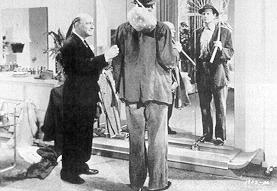 Thus we see Sullivan the next day walking down the road in hobo gear – followed by a fully furnished motor home filled with studio personnel. Sullivan hitches a ride with a young kid in a dune buggy and tries to lose the entourage. This sequence is a marvel of slapstick comedy as the motor home tries to keep up to the speeding dune buggy, and is reduced to a shambles in the process.
This fiasco just strengthens Sullivan’s resolve and he is able to convince the studio that they don’t have to have him followed. So off he goes again. We next see him chopping wood for a couple of women, and it soon becomes clear that the women don’t want him exclusively for chores, going so far as to lock him in his room. He makes his escape with that oldest of movie clichés – The rope made of bedding.
A breakfast stop at a roadside diner leads to a meeting with a down-on-her-luck wannabe actress (Veronica Lake), and the two strike up a friendship over coffee. What’s marvelous in this scene is the way that Sullivan keeps his secret from the girl, despite the fact that he really, really wants to tell her who he is.
"Give me a letter of introduction to Lubitsch."
"I might be able to do that – Who’s Lubitsch?"
The girl decides to go along with Sullivan on his travels (She knows the truth by now), and he starts making plans to jump a freight train. There’s a terrific moment when Sullivan’s butler calls the railroad office. "If a hobo were going to jump on the 5:48 train, where should he do it from?"
With Sullivan and the girl hopping trains and travelling around the country, Sturges takes a step back and lets us experience the journey as they do. We see hobos everywhere, sleeping outdoors and grabbing meals where they can. The Depression was still fresh in everyone’s minds in 1941, and we are quietly reminded of the devastation it caused.
This trip gives Sullivan the experience that he thinks he needs, but he makes the fateful decision to go out one last evening and distribute money to the tramps. The result is that he is beaten, robbed, and thrown unconscious onto a freight train. To top it all off, a violent altercation with a railway worker gets him thrown in jail.
Sullivan’s stint in jail leads to the scene that is the centerpiece of the film, when the convicts go to a "picture show" at a black church. They march in slowly, in chains, to the sounds of the congregation singing. The lights go down, and the audience is treated to a Disney cartoon of Pluto fighting a losing battle with a sheet of flypaper. The convicts roar with laughter and eventually so does the movie director who was tired of making comedies.
John L. Sullivan the director comes to realize that there isn’t anything wrong with giving people something to laugh at. Preston Sturges the director has it both ways. His films are textbook slapstick comedies, with pies in the face and people falling into rainbarrels, but he also dished out a little medicine with the sugar.
Sunday, May 07, 2006
Tuesday, April 18, 2006
Onibaba
The opening images of Kineto Shindo’s 1964 masterpiece “Onibaba” are soothing – A plain covered with long grass swept by wind. This is captured in gorgeous black and white photography, but it’s misleading. This isn’t a soothing story by a long ways. It’s a story that’s shot through with blood and sex.
The film centers on two women – an older one and her young daughter-in-law – and their needs are absolutely primal. They begin every day with the task of surviving, and they have developed a grisly commerce. They ambush and murder wandering samurai, and steal their weapons and armour to exchange for food. Indeed, the films’ opening images illustrate their handiwork, as two ronin are killed, stripped, and dropped into a deep pit.
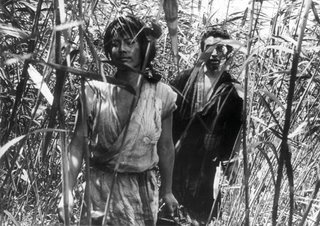
The two woman soon encounter the vagabond soldier Hachi, a friend of the old woman’s son Ushi. He has returned from fighting in the wars that are raging throughout the countryside, and he tells tales of how he narrowly escaped death and how Ushi wasn’t so lucky. Hachi is loud and exaggerated, and gives the impression of being one not to be trusted. The women certainly don’t, as they treat him with distain. They want to know about the death of Ushi, and if Hachi could have prevented it. The old woman later tells the daughter-in-law exactly what’s on her mind.
“He may have killed Ushi himself.”
It’s a second encounter with Hachi, however, that first lets us in on where the story is headed. The younger woman is sitting by a lake, pounding some laundry with a stick, when Hachi appears. He talks to the girl, and it’s obvious from watching his eyes that he desires her, as she sits barelegged and spread-eagled on the dock. The older one sizes him up immediately, and warns her. “He wants you.” Thus begins the bizarre triangle – the lecherous Hachi pursues the younger woman, and the older one desperately tries to keep him away.
Ah, but it’s not quite that simple. The younger woman succumbs to her needs and begins to visit Hachi in his hut at night. The older one follows her and watches as they have sex. She runs away from the scene and then stops and grasps her breasts then wraps herself around an old dead tree. The camera pans up the tree, and the sexual symbolism is unmistakable. Her primal urge to maintain her way of life is being challenged by another – her desire for sex.
The following day she goes to visit Hachi and finds him sleeping in the grass. The contradictions in the old woman are brought right to the surface in this brilliant sequence. She derides him as a useless bum as he sleeps, then wakes him and tries to induce him into sex. Shindo shoots Hachi lying on the grass, with only her bare leg visible, and then shoots her from below stepping over and straddling him. This subtle suggestion of sexual tension is masterfully done.
The tale takes a bizarre twist with the introduction of another character – A mysterious samurai who wears a hideous demon mask. The samurai asks the old woman to show him how to get to the main road. As the two wind their way through the long grass, the stranger tells why he wears the mask – to protect his face in battle, because he is extraordinarily handsome.
The old woman leads him directly into the pit, and he falls to his death. She climbs down into the hole to retrieve his valuables, and predictably succumbs to curiosity about this handsome face. She pulls the mask off with some difficulty, and in doing so seals her fate.
The following evening the young woman sets out through the grass for her rendezvous with Hachi, and in a hugely frightening scene, comes face to face with the demon. It’s not hard to figure out what’s going on here – The old woman is using the mask to frighten the younger one away from Hachi, but this takes a tragic twist on a rainy night. The young woman again sees the demon, and runs back home. She slowly gets a fire going in her hut, and the emerging light illuminates a huddled figure on the floor, back turned. The figure slowly turns and is revealed as the demon again. The masked figure starts to plead – “It’s me!!!!” “I can’t get it off!!”

It is revealed to the young woman that the old one has been scaring her, and that the mask had gotten attached to her face – Just as it did the samurai. The old woman pleads to have it taken off and in a chilling scene, the young woman tries to break the mask with a hammer as the old woman screams and cries.
The conclusion of “Onibaba” does not leave you with a neat resolution. Hachi meets his end at the hands of the last person in the world he expected to see, but for the women, it’s a bit unclear. Let’s just say the pit figures into things again.
What a frightening and imaginative thriller this film is! It was done on a budget of next to nothing, but creates images that are impossible to shake. There are no special effects, and no cheap scares. “Onibaba” creates its atmosphere through lighting, location, music, and character…and that brilliant demon mask.
Monday, April 17, 2006
The Red House
I have a notion to try and introduce a new film genre. This genre exists somewhere amongst film noir, the family drama, and the horror film – of the 40’s and 50’s. The films have the veneer of happy, well-adjusted family life, but there are terrible forces lurking underneath. You can go back to stuff like the old Ronald Reagan film “King’s Row”, and through movies like “Night of the Hunter”, “Hush, Hush, Sweet Charlotte”, and “Blue Velvet” right up to “A History of Violence” today. I’m going to call them “Norman Rockwell Gothic”.
That brings me to “The Red House”, a lesser known little marvel from 1947, directed by Delmer Daves. It is set in an idyllic little farming community, where the schoolkids wear letter sweaters and use the word “gosh”, and where farmers wear a suit to the dinner table. It’s the kind of portrait Rockwell would have come up with, but buried under its surface are lust, madness, and murder.
Farmer Pete Morgan (Edward G Robinson) lives on a quaint little farm with his sister, and his adopted daughter Meg. The Morgans are a nice bunch, but their isolation means that the townspeople talk and gossip about them, as their young hired hand Nate tells them his first day on the job. Nate says the rumour is that Meg’s parents ran off, but Morgan gently tells him that isn’t true - that they were killed in a car accident.

This first visit by Nate also provides the first indication that there’s something not right around the Morgan place. After dinner, Nate starts out for home and casually mentions that he’s going to take a short cut through the Ox-Head Woods. Morgan tries to dissaude him, gently at first – but then more forcefully and finally in a panic.“Nothing will prepare you for the screams that you will hear for the rest of your life!”
“Screams from where?”
“From the Red House!”
Nate won’t be talked out of it, and sets out at night with a gale force wind blowing. Once in the woods, of course, he hears or thinks he hears the screams, and the film brilliantly evokes a sense of disorientation and panic. The shaken teen ends up back at the Morgan place for the night.
Nate is not the type to scare easily, and the experience in the woods makes him really curious about the red house, and what is spooking Pete so much. A second trip into the woods results in being knocked unconscious after getting attacked by an unseen assailant.
Soon afterward, there is a meeting in the forest between Morgan, and Teller, a shadowy hunter that we have met briefly at the start of the film. It is revealed that Teller has been given hunting rights in the woods, in exchange for “Keeping trespassers out”. The attack on Nate is thus explained, but this also amps up our curiosity about the red house, especially when Morgan tells the hunter, “I don’t want to see anyone hurt, but if a bullet were to just miss someone….”
Meg has by now begun to act upon her own curiosity about the red house, and whilst on a walk by herself, actually finds it. There is no masking the fact that Meg has some connection to the house, as Theremin music wells up on the soundtrack, and her attention is drawn to the farm’s icehouse. She relates this experience to Nate. “ I don’t know how I know it was the ice-house, but I just do."

Morgan begins to lose his grip on reality as the two teens get closer to the secret of the red house. In visiting Meg in her room, he makes a telling slip, calling her “Jeannie.” This goes uncommented upon, but in a later exchange at the swimming hole, Morgan appears to suffer a breakdown, as he addresses Meg as Jeannie again. This time it’s clearly not just a slip – He actually is speaking to Jeannie, and Meg has now figured it out.
Meg ventures back to the red house, this time going inside, and she now understands that it was her home once upon a time. Morgan follows her there.
“Who is Jeannie, Pete? Is it short for Genevieve? My mother?”
Finally, Morgan spills his terrible story – About a woman who he loved and how he came to kill her and her husband, and how he disposed of their bodies in an icehouse.
Robinson is simply marvelous in this role, as he was in most of his roles. He watches with mounting unease as his past comes back to destroy him, and in his final act, sits stonefaced as the water in the icehouse comes up and over him. There’s a tiny, but perfect little coda, as well. As Morgan truck goes under the water, a lone surrey wheel floats to the surface – A reminder of a long-ago crime finally uncovered.
Footnote: A couple of points. I mentioned the use of the Theremin on this soundtrack. It might seem a strange choice, but the way it creates unease and tension is invaluable.
Also, as great as this film is, it has a lot of padding. There is a silly subplot about Nate’s mother which should have been taken right out, and there’s another about Nates girlfriend Tibby and Teller, which is notable only for the presence of a white-hot young Julie London
.Tuesday, March 21, 2006
Accatone
Rome has traditionally been presented in film as a beautiful, vibrant city of life. Pier Paulo Pasolini, in his 1961 debut "Accatone", takes that image and blows it to smithereens. Pasolini’s Rome is one of pimps, hookers, run-down shacks, and petty crime.
We first meet the title character as he sits at a grubby sidewalk café with his pimp buddies. A passerby derides them for their sloth, asking "Are your women on strike?" Accatone relates a story of one of their group who tried to eat a full meal and then swim across the Tiber, and died for his foolishness.
We meet Accatones’ "family", which consists of his whore Madalena , and the wife and children of a jailed friend of his. The whore has just been injured in a motorcycle accident and Accatone comes to check on her. The thing in this scene that strikes you is Accatones’ callousness and disregard for the woman – He starts out berating her for getting hit, and then remarks on her bandaged leg. He asks sarcastically "Did they think you were going to lose it?" Clearly, he thinks the bandages will be bad for business, because bad leg or not, she’s going back to the street.

Pasolini doesn’t give us much in the way of direct information, but there are clues that let us fill in the blanks. It is assumed that the period we are looking at is not too long after the war, and it appears that Accatone has been fairly well-off, but has now fallen on hard times. Early on he stops to play with a small child in the street, and says "Don’t you recognize me? I’m your papa." We briefly meet his ex-wife, who is living with her brother and father, and it’s made pretty clear that Accatone is not wanted around them. The brother even gets into a fight with him in the street.
Time and time again we see the contradictions in the life of this pimp. He spends a lot of time lamenting the life he leads, and saying that he has no future, but the thought of work terrifies him, and he feels no remorse at cheating his friends. He meets the virginal Stella one-day, and is clearly smitten by her. He follows her around and begins a relationship with her. At first, we start to believe that Accatone may have turned a corner in his life, because he tells her that he is attracted to her innocence and helplessness. She is dirt poor and Accatone tells her that he will buy her a new pair of shoes. We wonder how he’s going to do this, since he’s just about as poor, and then we see him back talking to his son on the street , and as he gently removes his son’s gold chain, we finally see Accatone for what he truly is.

We now begin to fear his motives for the beautiful Stella, as we suspect that he has designs on her whoring for him. At a nightclub, Accatone is approached by a couple of rich men, who want to spend some time with his woman. Stella is hesitant, but he pushes her towards them. "Just dance with the man", he tells her. Afterward, of course, he browbeats her for going with them, and "making me look like a fool." Stella is rightly confused, replying "But I thought you wanted me to."
It is now clear that he isn’t going to be able to make a whore out of Stella, so he now has to try other avenues. We’ve briefly met his hard-working brother, and he is able to get Accatone a job gathering up scrap metal, but this isn’t going to work either, since it involves real work. He lasts only one day. Finally he hooks up with a friend who employs a bunch of youths to do petty larceny for him.
Pasolini has done a very unique thing in "Accatone". He has taken a character who is an unscrupulous bum, and surrounded him with like characters, and just let them go on their way. There’s no effort to romanticize him or explain him. The Accatone who meets his fate at the end of the film is consistent with the scumbag that we met at that café at the beginning. We may have hated him or pitied him, but we never wanted to turn away.
Monday, March 06, 2006
The Blue Angel
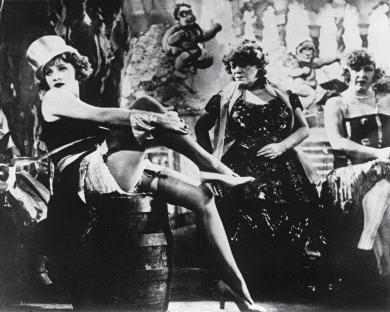 The above image is arguably the one most moviegoers would think of first when Marlene Dietrichs’ name is mentioned. Dietrich was an actress who got called an "icon" – a brand name, if you will. This movie was "The Blue Angel", and it’s really where the Dietrich legend got started. Indeed, the story in "The Blue Angel" has a couple of parallel stories – those of its stars: Dietrich and Emil Jannings
Jannings plays Professor Rath, a stogy Literature professor at a small college. We see his cleaning lady grouse about how his apartment is piled high with books and reeks of cigar smoke, and we realize that this is a man who leads a cloistered life.
One day in class, he confiscates a sexy postcard from his students, and finds out that some of them have been stealing out at night to see the girl on the postcard. That would be the nightclub singer Lola Lola (Dietrich). He finds himself in her dressing room and tries to berate her for corrupting his students, but she is breezy and carefree with him, and he is completely flummoxed. She takes off her nylons in front of him, and when she drops her panties down to him as she climbs the stairs, his goose is cooked.
Rath contrives to go back the following night, and this time decides that he has to rise to defend her honor against a drunken sailor. One criticism of this movie is that there really isn’t the feeling that she should care about this old man, but watch Lola in this scene as Rath forcibly throws the sailor out of her room. The camera goes to her, and you can see that she is touched by this gesture – That a man is defending her honor. The next thing we see is Rath waking up in her room after an apparent sexual encounter.
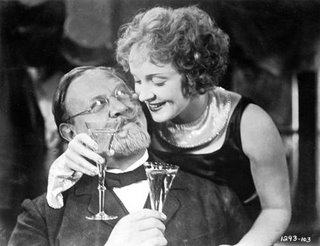 Rath’s colleagues at the college have heard about this by now, and his superior basically tells him that he can’t jeopardize his career by hanging around with a woman like that. Rath pulls himself up and says, "You are talking about my future wife." Soon the professor has quit his job, married Lola and moved in with the travelling revue with her. Rath goes through a physical transformation, as he grows slovenly and bitter in his new life. There is a terrific little montage of him testing the heat of a curling iron that indicates the passing of four years.
By this time, Rath is part of the show – He dresses like a clown and is the "appentice" of the magician Keipart. Finally the revue returns to Rath’s hometown, and he faces the prospect of going on stage in front of former colleagues and friends. To make matters worse, Lola is beginning an affair with a handsome strongman, and is doing so in plain view. So we come to the film’s climax – Rath goes onstage and is humiliated publicly – He is forced to crow like a rooster while Keipart cracks eggs on his head.
‘The Blue Angel" is notable on its’ own merits, but also because of the people involved. This was the first collaboration of Dietrich and director Josef Von Sternberg. They made seven movies together, including "The Scarlet Empress" and ""Shanghai Express". The partnership was such that it’s impossible to think of one without the other.
Then there is Emil Jannings, a textbook case of life imitating art. In many of his most famous roles, he played a man in a position of respect who is brought down. In addition to "The Blue Angel", there was his hotel doorman in Murnaus’ "The Last Laugh", and his earlier work for Von Sternberg in "The Last Command". In real life, he was an enthusiastic endorser of Hitler, and made pro-Nazi films for Goebbels. After the war, of course, he was an untouchable and he never made another film after 1945. Like Professor Rath, he made a decision and suffered the consequences.
Subscribe to:
Posts (Atom)