Jon Voight stars as Manny, who is a lifer at a maximum-security prison in Alaska. We find out as the story opens that he has just won a court challenge to be released from solitary confinement into the general prison population. He has just spent the past 3 years with his cell welded shut, courtesy of Rankin, the prison’s sadistic Warden. The dynamic between these 2 men is established early, as Rankin delivers the news of his court win to Manny. “I hope you try something – I will send you out of here in PLASTIC!!” Manny, in fact, IS planning something – He immediately starts to work on breaking out, with the help of the slow-witted trustee Buck (Eric Roberts). Once out, the two have to make on a cross-country trek through brutal winter conditions, until they happen upon a remote train station. They jump on the titular train, and the film settles into its groove.
The two have unknowingly picked the worst possible train, as the conductor dies of a heart attack shortly after they start moving, and the locomotive starts to pick up speed. Here the film picks up a second plot thread as a railroad dispatcher office discovers the out of control train and begins to try to deal with it. Believing the train to be unmanned, the dispatchers make plans to de-rail it, and instruct an on-site switchman to switch it onto another track. However, in waiting for it to arrive at the switch, he hears the whistle blowing, and in a memorable scene holds his radio handset out the window for the office to hear. The switch is narrowly averted.
Manny and Buck are as surprised as we to hear the whistle, and this leads to the discovery of a third person on the train – A female railway worker. The girl is able to provide us with some valuable information – The train can be slowed down by unhooking the locomotives one at a time, but you can’t get from the second to the first engine because there are no handrails.
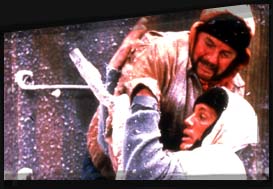
By this time, Rankin is in pursuit via helicopter, and we begin to see how the film parallels he and Manny. In surmising that Manny has jumped on a train, Rankin says with glee “He’s doing exactly what I would do.” Rankin finally catches up to the train and climbs down a rope ladder in order to board it. This sequence is simply spectacular, as the train hurtles through a snowy mountain pass, with the man hanging from the chopper above it. Manny has managed to get to leap to the front engine in the meantime, and it’s here where the final confrontation with Rankin takes place. The two men battle, and Rankin ends up handcuffed to the train. Rankin hurls insults at Manny, but it’s clear that Manny is now in a place where he can’t be touched.
“You’ll die , convict!”
“You’ll die with me”
“Fuck you! You’re as afraid to die as anyone else! And I never let you free”
“I’m free, Rankin…..I’m free”
I mentioned at the beginning of this piece that you will overlook a lot of stuff if a film grabs you by the cajones. “Runaway Train” is far from a perfect film. Rankin is painted as a bit too much of a cartoon sadist, and Eric Roberts’ Buck is best taken in small doses. If you look beyond those things, you see marvelous images and stuntwork, and a tour de force performance by Jon Voight. There is a quiet moment where Manny listens to Buck go on about what he’s going to do on the outside, then interrupts with a marvelous monologue about the reality about what their lives have become and how Buck will end up with some menial job. “And you will treat that job like gold, because it IS gold.” When Buck asks why Manny doesn’t do the same, Voights’ answer is simple, beautiful and wistful - “I wish I could.”
In a film chock full of memorable images, however there is one that stands out above all the rest, and that is the final one. A quote from Richard III appears onsceen as the train and its two occupants fly off to their ends. “No beast is so fierce but knows some touch of pity. But I know none, and therefore I am no beast.”

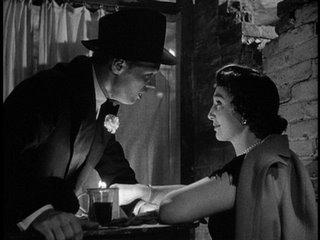


 The second story revolves around Pedro, an elderly sugar cane farmer. Pedro works his land with his son and daughter, and his story is told in an astonishing dream sequence which lasts only a few seconds, but which speaks volumes. One day he is visited by the owner of his land who announces that it has been sold to a large fruit company, and he will have to move out. Pedro goes back to work and Kalatozov depicts him cutting cane in a frenzy of machete strikes and metallic ringing. Finally, a defeated Pedro sends his children to town and torches his crop and farm.
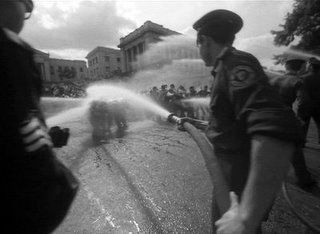 Story Three is in many ways the most powerful of all, as student activist Enrique backs out of an attempt to assassinate a murderous cop, and promptly sees the same cop kill one of his colleagues. Police with fire hoses then interrupt a huge student rally, and Enrique comes face to face with the corrupt cop once again. This sequence achieves creates incredible energy as the crowd is whipped by hose spray and smoke. This segment concludes with a sequence where the camera follows a funeral procession, the leaves it to climb the side of a building, where it pans through a room of men rolling cigars, then goes over the balcony and seems to glide in midair over the procession again. It’s truly a virtuoso bit of cinematography.