Saturday, March 22, 2008

Call It

What's the most you ever lost on a coin toss?

Sir?

The most. You ever lost. On a coin toss.

I don't know. I couldn't say.

Call it.

Call it?

Yes.

For what?

Just call it.

Well, we need to know what we're calling it for here.

You need to call it. I can't call it for you. It wouldn't be fair.

I didn't put nothin' up.

Yes, you did. You've been putting it up your whole life you just didn't know it. You know what date is on this coin?

No.

1958. It's been traveling twenty-two years to get here. And now it's here. And it's either heads or tails. And you have to say. Call it.

Look, I need to know what I stand to win.

Everything. How's that? You stand to win everything. Call it.

Alright. Heads then.

Well done. Don't put it in your pocket, sir. Don't put it in your pocket. It's your lucky quarter.

Where do you want me to put it?

Anywhere not in your pocket. Where it'll get mixed in with the others and become just a coin. Which it is.

No Country for Old Men - Screenplay by Joel and Ethan Coen

Friday, March 14, 2008

The Marquee

The Creature from the Black Lagoon, 1954

Monday, March 10, 2008

Bernard Herrmann, part 2

As long as we're listening to great Herrmann scores, here's the best of them all - The great, soaring theme for North By Northwest. Enjoy.

Sunday, March 09, 2008

Remembering Bernard Herrmann

One thing missing from my commentary on The Ghost & Mrs. Muir was a mention of Herrmann's gorgeous score. By way of rectifying that, here's the opening credits.

Friday, March 07, 2008

My Week of Movie Watching

The Harder They Fall (1956) – Humphrey Bogart’s last film, and one of the sourest flicks ever to come down the pike. It tracks the rise to a no talent Argentine giant to the top of the heavyweight boxing ranks. (It’s based loosely on the career of the “Amblin’ Alp”, Primo Carnera). Bogie is good as a down-on-his luck sportswriter who gets stuck in a shady enterprise and can’t get out of it. The film, however, belongs to Rod Steiger, in classic scenery-chewing form as a heartless promoter.

Gate of Flesh (1964) – Another foray into the work of the Japanese maverick Seijun Suzuki. Like him or hate him, Suzuki never bores. This is a tale about a small band of prostitutes who gang together in post-war Tokyo, and try to survive with the help of a strict code of behavior. Their closed world is disrupted by the arrival of a wild ex-soldier. The film is a comment on the societal sickness of post-war Japan, and it’s a nasty one. Some will squirm at its violent /porn depictions of savage whippings and of a cow being butchered onscreen. It’s not an easy watch, but I do recommend it.

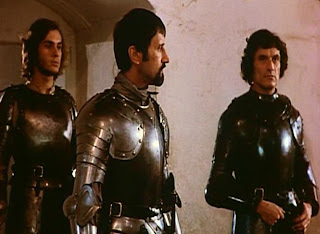
Lancelot Du Lac (1974) – Robert Bresson’s version of the King Arthur saga concentrates on the love affair between Lancelot and Guinevere, and its final tragic consequences. This one is a heavy slog, even by Bresson's standards, as he spends an inordinate amount of screen time on totemic shots of feet, hands, door handles, etc. The film seems to suggest that the pride and arrogance of the two lovers leads to the destruction of the Knights of the Round Table. That’s my best guess ,anyhow.

Thursday, March 06, 2008

The Ghost & Mrs. Muir

“This is the Twentieth Century.”

That line is spoken several times throughout Joseph Mankiewicz’ The Ghost & Mrs. Muir, and it contains the seed which lies at the heart of the film. G&MM is, I suppose, a romance – a love story, but in many ways it rejects the shop-worn concept of living “happily ever after.” It’s a twentieth century take on things.

Gene Tierney is the Mrs. Muir of the title, a recently widowed young mother in turn-of the century London. We first meet Lucy Muir as she discusses her plans to move out of the mother in laws home. She is still technically in mourning at this point, but she displays not a hint of sorrow or sentimentality as she talks to her mother and sister in law. When her late husband’s name is brought up she coolly replies, “But Edwin is dead.” It’s a tiny glimpse, but it illustrates what kind of marriage she is coming off.

She finds herself in a seaside cottage on the ocean, despite the repeated efforts of the local land agent to dissuade her. Despite his comments that “You wouldn’t be interested”, something draws her to the place, and she moves in. Soon enough, however, we see why the property values were so low. This cottage already has an occupant - The ghost of a seaman named Captain Gregg (Rex Harrison). Gregg is not a bad sort, despite his language and gruff manner, and Lucy’s original fear slowly gives way to fascination and fondness for this doppelganger.

The earthy sailor and the prim lady are therefore now living (sort of) under the same roof, and the film winks at the sexual possibilities that come with this situation. At one point as Lucy lies in bed, she hears Gregg intone, “Don’t let anyone tell you that you should be ashamed of your figure!”

The exchanges between these two are what start to really reveal Lucy Muir. Captain Gregg, you see, seems to know everything about Lucy, perhaps more than she knows herself. Consider this exchange about her ex-husband.

“You didn’t love him”

“How dare you say that?”

“Because it’s true. You were fond of him, perhaps, but you didn’t love him.”

Lucy goes on to talk about how Edwin was an architect, “But not a very good one. He couldn’t have designed this house. Who DID design it?” and Gregg replies with satisfaction “I did.” It’s at this point where it becomes plain that the ghost and Mrs. Muir have a kinship that goes beyond mere affection.

Lucy begins writing Gregg’s memoir, marvelously titled “Blood & Swash”, and the film has a bit of fun with the Production Code here. At one point, Lucy hesitates at one word, and only after exhortation from Gregg, does she type it – In four distinct keystrokes. The ghostwriting allows Lucy a look into the exiting manly life of the Captain, and her own life comes up short in comparison. Earlier, when she was with her in-laws, she said that she’s never had her own life, and that sentiment comes up here again. Gregg tells her that she should be out amongst the living, including with other men.

Unfortunately, she gets her chance, in the arrival of George Sanders as the impossibly droll and sophisticated Miles Fairly, a wealthy writer of children’s books. Fairly is handsome and charming, and Lucy falls for him, against the wishes of Captain Gregg. The new man is kind and generous, but there’s something about him that’s not right. Gregg sees it, Lucy’s housekeeper sees it, and we even sort of see it, when he jovially describes the children he writes for as “little monsters.” The ghost is absent for most of the section of the movie involving this romance, and it’s by design, I think. It seems that Gregg is letting her go her own way, even if he thinks she’s making a mistake. Which she is, as she eventually discovers.

So, what to make of TG&MM? Lucy Muir’s story is also the story of how 3 men affect her life. There’s her late husband, and Miles Fairly, both fond of her and kind, although with very little under their surfaces. She ends up feeling unfulfilled by both. Then there’s Captain Gregg. He’s the one who really understands her, and tells her what she needs to hear. The problem is, he’s dead. Why does the film present a love interest that can never really be a love interest? My thought is that the film isn’t really about Lucy’s quest for love, but rather about her quest for emancipation. That’s why Lucy keeps telling people that this is the 20th century. It’s a new era, and the old norms of romance and fulfillment don’t necessarily apply anymore.

The ghost visits Lucy near the end of the film, and as she sleeps, tells her that it wasn’t him channeling the book to her, that it was just her alone. That theory was always out there – That the ghost was just a figment of Lucy’s imagination, and that she found her way to emancipation by herself. The truth is left ambiguous, and I’m glad. At one point early on Gregg recites from Keats’ “Ode to a Nightingale”

“Charmed magic casements, opening on the foam, of perilous seas, in fairy lands forlorn”

That fits Captain Gregg to a T, but go a bit further in the same poem and you find a stanza that might have been written for Lucy Muir.

“Was it a vision, or a waking dream? Fled is that music – Do I wake or sleep?”

Wednesday, January 30, 2008

On This Date

One of filmdom's classic heavies was born. Mr. John Ireland (1914). He's pictured here in Anthony Mann's Raw Deal.

Tuesday, January 29, 2008

The Marquee

Querelle - Dir. Rainer Werner Fassbinder, 1982

Saturday, September 29, 2007

Hopsie & Jean

Oh darling, hold me tight! Oh, you don't know what you've done to me.

I'm terribly sorry.

Oh, that's all right.I wouldn't have frightened you for anything in the world. I mean if there's anyone in the world I wouldn't have wanted to - it's you.

You're very sweet. Don't let me go.

Snakes are my life, in a way.

What a life!

I suppose it does sound sorta silly. I mean, I suppose I shoulda married and settled down. I imagine my father always wanted me to. As a matter of fact, he's told me so rather plainly. I just never cared for the brewing business.

Oh, you say that's why you've never married?

Oh no. It's just I've never met her. I suppose she's around somewhere in the world.

It would be too bad if you never bumped into each other.

Well...I-
I suppose you know what she looks like and everything.

-I think so.
I'll bet she looks like Marguerite in Faust.

Oh no, she isn't, I mean, she hasn't, she's not as bulky as an opera singer.

Oh. How are her teeth?

Hunh?

Well, you should always pick one out with good teeth. It saves expense later.

Oh, now you're kidding me.

Not badly. You have a right to have an ideal.

Oh, I guess we all have one.What does yours look like?

He's a little short guy with lots of money.

Why short?

What does it matter if he's rich? It's so he'll look up to me. So I'll be his ideal.

That's a funny kind of reason.

Well, look who's reasoning. And when he takes me out to dinner, he'll never add up the check and he won't smoke greasy cigars or use grease on his hair. And, oh yes, he, he won't do card tricks.

Oh.

Oh, it's not that I mind your doing card tricks, Hopsie. It's just that you naturally wouldn't want your ideal to do card tricks.

I shouldn't think that kind of ideal was so difficult to find.

Oh he isn't. That's why he's my ideal. What's the sense of having one if you can't ever find him? Mine is a practical ideal you can find two or three of in every barber shop - getting the works.

Why don't you marry one of them?

Why should I marry anybody that looked like that? When I marry, it's gonna be somebody I've never seen before. I mean I won't know what he looks like or where he'll come from of what he'll be. I want him to sort of - take me by surprise.

Like a burglar.

That's right. And the night will be heavy with perfume. And I'll hear a step behind me and somebody breathing heavily, and then.….. You'd better go to bed, Hopsie. I think I can sleep peacefully now.

I wish I could say the same.

You know how you’ll hear snooty film types lament about how nobody writes great dialogue anymore? Well, it happens to be the truth. The example above could be exhibit A. It’s taken from Preston Sturges’ great 1941 comedy The Lady Eve, and it illustrates what I mean quite nicely. Barbara Stanwyk as Jean and Henry Fonda as Charles (“Hopsie”) are two people who find themselves in love when neither expected to be, and we see it blossom right before our eyes. In only a few minutes of screen time we see nervousness, intelligence, charming silliness…and finally, lust.

It’s fun to watch the great screenplays of the Hays Code era, and watch how writers slyly dealt with sex. Sturges was a master at it, whether it’s Betty Hutton’s one-night-stand in The Miracle of Morgan’s Creek, the two horny spinsters in Sullivan’s Travels, or Barbara Stanwyck playing with Henry Fonda’s hair while making snake talk. Because , you see, they don’t write stuff like that anymore.

Henry Fonda, Preston Sturges, and Barbara Stanwyck on the set of The Lady Eve

Monday, September 17, 2007

I Hate filmscreed

Yeah, I kinda do. Let me ‘splain why.

This blog got started way back when because I was getting an itch to do a bit of writing. I had been poking around Usenet in the film groups and had tried my hand at some short commentaries, and this had whetted my appetite for more of the same.

It was about at this time that the concept of the weblog started to really gather steam. A Usenet acquaintance named Tom Sutpen had started his own blog, and as I read it, I began to think why not? This was the perfect forum for what I wanted to do – To write about something I was passionate about. Thus, filmscreed was born in the fall of 2005, featuring an essay on Kon Ichikawa’s Fires on the Plain. My intent was always to do commentaries on off-the-beaten-track stuff, just like my blog description says.

I was trying to sit down, do the toil, and perhaps create something worthwhile. In looking back at those first entries, I see that they were far from perfect, but they were at least created with enthusiasm. After a while, however, I started to be bothered by the small number of responses I got, and I began to think that doing an entry every two or three weeks wasn’t enough, that people needed a more steady diet or they’d get bored.

That’s when I decided to start supplementing the blog with photos and film posters, thus keeping a more steady flow of material out there. This was interesting, and it was kind of fun to hunt up stuff to put online.

The change was gradual, and it was abetted by some changes in my life. A new job cut drastically into my free time, making watching movies a lot more difficult, and writing about them nearly impossible. The result was that the blog became saturated with “quick & easy” stuff – Photos, movie posters, magazine covers, and writing took a backseat. When I did write, I had to cram it into the rare bits of free time I had. The quality suffered for it, culminating in the piece I did on Underworld Beauty a few weeks back. It was sloppy, I wasn’t happy with it, but I posted it anyway.

So, now I have made a decision. I briefly thought about just shutting down the site, but decided that that wasn’t an option, so I am just going to dedicate myself to re-inventing filmscreed the way I originally envisioned it – An "insufferable film snob" writing about movies. The posts will be more infrequent, and the film posters and other images aren’t going away completely (I’ve got waaaay too many of them on my hard drive, and I’m not going to have done all that for nothing, dammit!) but the focus will be put back on me sitting at a keyboard and hammering out my thoughts on movies.

If you are one who reads this blog with any regularity, I hope you continue to. I've got a lot of stuff that I want to talk about, and a lot of work ahead of me. Please, just be patient with this time-challenged amateur scribbler.

Thanks

Jeff

On this Date

A Happy 62nd to Mr. Bruce Spence, a.k.a. The Gyro Captain.

The Marquee

Thursday, September 06, 2007

Tuesday, September 04, 2007

The Marquee (Hopper redux division)

Likely the worst film I ever saw, man.

Monday, August 27, 2007

Semper Fi

There’s a moment in John Dahl’s Red Rock West that some might look at and wonder why it’s there. It’s the first meeting between Nicholas Cage’s Michael and the hired killer known as Lyle from Dallas (Dennis Hopper)

Hopper gives Cage a ride, and they discover that they have something in common – They were both Marines. Cages’ Michael is, in fact, is a survivor of the horrific 1983 Beirut truck bombing that claimed the lives of over 200 Marines. Lyle exclaims, “You’re one lucky Son-of-a-bitch!” and Michael replies with a bit of irritation “I KNOW I was. 241 guys weren’t.”…And Lyle nods softly in agreement.

The Marine connection surfaces again at the films climax, in the form of a little tongue-in-cheek visual joke, but what makes this moment so memorable for me is that this is one of the rare times where a film takes a few moments to prise open a bad guy and shine a little light in. Lyle is a cold killer, a Hopper loony to rank alongside his best, but in this small, seemingly insignificant moment, we get to see him for a tiny bit more.

Thursday, August 23, 2007

Underworld Beauty

For a film lover, there’s not much that can top the pleasure of seeing something that you know nothing about, and having it just blow your doors off. Such was the case with Underworld Beauty, my first dabble in the work of the Japanese master Seijun Suzuki. This film has got a lot of things I love – Cool, tough men, sexy tough women, and a bit of depravity thrown in for good measure. Simply put, this is a great film.

We first meet Miyamoto as he walks down a deserted sewer, dislodges a brick from the wall and removes something from the other side – A gun and a small bag of diamonds. This opening sequence nicely introduces the hard-as-nails underground world of UB, and does so without a single word of dialogue. We can guess that Miyamoto is a guy who has just gotten out of prison and is recovering his hidden loot, but an early meeting with a crime boss puts an unexpected spin on things. It turns out that Miyamoto wants to sell the diamonds in order to help out his old partner Mihara, who lost a leg in the job that sent Miyamoto to prison.

The rooftop meeting to sell the jewels goes bad when several masked men interrupt it. Rather than give up the diamonds that he paid such a price to obtain, Mihara swallows them and leaps off the building to his death. The bad guys all have a dilemma now: Their diamonds are in the stomach of a dead man, and the body is in the hands of the law.

This, folks, is where the story takes a twist towards the macabre. We have already briefly met the dead man’s younger sister Oyane, and her artist boyfriend Arita. These two know where the diamonds are, and during a last viewing of Mihara’s body, Arita distracts his girlfriend long enough to recover the stones from inside the dead body.

One thing that strikes you as you watch this film is the America-fied air that it gives off. The story, its B&W, wide-screen presentation, and jazzy score could have been lifted wholesale from some of the great American noirs, like Pick-up on South Street or Kiss Me Deadly. The “hero” Miyamoto with his leather jacket and black fedora looks much more like a North American construct than any traditional kind of yakuza. This film walks in the tough-guy footprints laid down by people like Sam Fuller.

I put hero in quotes above because, although Miyamoto is the hero in the strictest sense of the word, he is far from a virtuous knight errant. There’s no suggestion that he didn’t deserve to be in prison, and throughout the film he carries himself with the air of someone who is not to be messed with. There’s a scene early on where he walks into a raucous nightclub, and everything comes to an abrupt halt. His quest to recover the jewels and his efforts to protect Oyane after her brother’s death are tied to what he likely sees as a duty to his former partner, and nothing more.

Arita now seems to have everything wrapped up, because no one else knows that he has the diamonds, everyone believing that they were cremated along with Mihara. It all goes up in smoke, however, when Miyamoto visits and intercepts a damning telephone call. Miyamoto thus recovers the diamonds and sets UB’s marvelous endgame into motion. On one side Miyamoto with the diamonds, and on the other side the crime syndicate who are holding Oyane hostage.

Underworld Beauty is a marvelous-looking Noir, and never more so than in its finale, when Miyamoto goes to the mansion of the head bad guy to settle things up. The final showdown is lengthy and makes good use of the house with its shadowy hallways and Western-style look. Miyamoto and Oyane are pinned in a corner of a dark, steamy basement, and work together frantically to burrow their way out through a coal chute. It’s a terrific set piece, shot through with soot, sweat, and gunpowder. Rescuing a girl never looked like such hard work before.

A final note – My profuse thanks to Tom Sutpen (The David Ortiz of film bloggage) for providing me with a copy of this little jewel.

Tuesday, August 21, 2007

On Location

Fritz Lang (front of car) sets up a shot for the great Metropolis (1927)

The Marquee

Wall Street, 1987

Friday, August 17, 2007

On this Date

A happy 87th to Maureen O'Hara, born on this date in 1920