Monday, April 22, 2013

My Week of Movie Watching


Other Men’s Women – Another pre-code curio from William Wellman., this one from 1930. It revolves around a couple of rail engineers - One happily married, the other a drunken playboy. Trouble ensues when the married one invites his buddy to stay with him and his wife (Mary Astor), and the drunk falls for the wife. This was a grind for me up until the time that the cheating starts, and then it got considerably more interesting ,as the adulterers (although they don’t appear to have sex) deal with what they have done to the cuckolded husband. The film builds to a conclusion that would seem to be logical, except that it flips the characters from what you would expect. As a result, it leaves a bit of a funny taste in the mouth. A lukewarm recommendation.

The Drive By Night – Humphrey Bogart and George Raft in a trucking drama from Raoul Walsh. The two leads play a couple of brothers trying to make a go of it in the trucking industry. They strike up a deal with a wealthy former colleague (Alan Hale) for steady work, but things are complicated by Hales' bat-shit crazy wife (Ida Lupino) who once was involved with Raft and still wants him. Bogie is only fourth-billed here, and wouldn’t really explode until the following year with High Sierra and The Maltese Falcon. Thus, it’s not really a Bogie role, and it’s a bit distracting. Lupino is sexy and suitably vile as the femme fatale. Recommended.


One Wonderful Sunday – A lesser known Kurosawa from 1947 traces a pair of young lovers as they struggle with crushing poverty. This is pretty good, if a tad contrived. Some of the situations are a bit predictable, like finding themselves short on a restaurant bill, but there are also some moments that are utterly charming, including an impromptu baseball game. The specter of WWII hangs over everything (the guy is an ex-soldier), and the shots of a ruined Tokyo add an extra melancholy to the story.


Scandal – Another pre-fame Kurosawa. This stars Toshiro Mifune as an artist who unwittingly ends up in a sex scandal involving a beautiful singer (Shirley Yamaguchi). The film follows their efforts to fight the sleazy tabloid that published the story. This film was truly an unanticipated little gem, mainly for the performance of the great Takashi Shimura as the couples’ self-loathing alcoholic lawyer. Shimura’s Hirutu means well, but is weak. He succumbs to his vices and then feels worthless afterwards. In some ways, it foreshadows his greatest role as the disenchanted bureaucrat of Kurosawa’s Ikiru. Very highly recommended.

Monday, March 18, 2013

On Location


Frank Sinatra and Laurence Harvey have a laugh on the set of The Manchurian Candidate

Sex

 
Claudia Cardinale

Wednesday, March 13, 2013

My Week of Movie Watching


Crazed Fruit – Strange name, great film. This 1956 offering from director Ko Nakahira takes its name from a slang term for the post-WWII generation of spoiled Japanese youth. Fruit tells the story of 2 brothers and the girl that one, then the other falls in love with. The problem is, she isn’t what she seems to be. The film presents a group of young men who live in a world of wealth, women, drinking and irresponsibility. It’s not by accident that there doesn’t seem to be an adult close to them. The love between the sober, younger Haruji and the beautiful Eri seems to be storybook stuff, but unbeknownst to him, she is also involved with his worldly older brother. The films conclusion is simply one of the greatest I’ve ever seen, and I guarantee it will stay with you long after you see it. Highly recommended.
The Purchase Price – Pre-code William Wellman tidbit from 1932 stars Barbara Stanwyck as a woman on the run who becomes a mail-order bride for an uptight farmer. There isn’t much to recommend here – The films' tension is supposed to be developed by whether the farmer (George Brent) finally succumbs to Stanwycks charms. The problem is there is no reason why she should love him – He has all the charm of a bowl of cold porridge. This disc is part of the series of pre-code “naughty” films, but this one is a bit on the tame side. The only bit that is kind of clever is a scene that Stanwyck does on a train with 3 other mail order brides. The conversation is funny in that silly double entrendre way, and the fact that one of the women is eating a banana is surely not a co-incidence. Not really recommended, however.

Tuesday, March 12, 2013

Monday, March 04, 2013

The Movies of My Life


The films of Sam Fuller are tough – It’s imprinted on their DNA. Fuller wasn’t just a Hollywood pseudo-tough guy poseur. Having worked in his teens as a crime reporter, and having worked a pulp writer, and as an infantryman in WWII, he earned his bona fides as a hardscrabble guy. That background is why his films have that hard edge to them that never seems anything but genuine. My favorite Fuller films are film like that, films that have that gruff, unsentimental vibe to them. I’m thinking of Pickup on South Street, and of Steel Helmet, with its crusty, cigar-chomping sergeant played by Gene Evans (a Fuller avatar if there ever was one!). But most of all I think of my favorite Fuller film, the little-seen Underworld USA from 1961.

Underworld belongs in the tradition of man-going-after-bad-guys-who- done-him-wrong gangster films, but I think the reason I think it stands apart from most of them, is the way it treats its “hero” Tully Devlin (Cliff Robertson). This is a guy who is as sentimental as a set of brass knuckles - a true anti-hero.

When a teenaged Tully (David Kent) witnesses his father’s murder, he’s not a babe in the woods. He is already someone who seems destined for jail as a thief.  We’ve already seen him lift a wallet off a drunk. The father is a street hustler also, and that’s probably why he found himself in that dark alley at the wrong time. When the cops come to investigate the crime, Tully doesn’t co-operate, even though he knows one of the killers. In his mind, he’s already planning his revenge.

The film shows Tully getting in more trouble, and going to jail. This development is beyond inevitable – it’s intentional. Tully throws a rock through a window when he knows there’s a copy right around the corner.

It’s while he is in prison that he learns that one of the murderers is in the same jail, and is near death. Tully arranges to get transferred to the prison clinic in order to get close to the dying man. When he finally confronts the killer, it’s a bit unsettling. The old man is sick and very close to the end, and when Tully tells him who he is, the killer begs for forgiveness. Tully coldly informs him that he will forgive him - If he gives the names of the other three killers. I find myself conflicted in this scene. Although I want the killers to pay for their crime, it’s easy to feel pity for the dying man, because he seeks absolution for his crime. Tully’s forgiveness, however, isn’t genuine – It’s just a step in the process. He’s the one who comes across as the monster.

Tully now finds himself out of jail, and now knows the names of the men he wants. Problem is that all three are powerful crime lords, and getting to them will be next to impossible. During a late-night spying session at the home of one of the killers, he catches a break. A hired killer (a cool and cruel Richard Rust) brings in a female drug mule with the intention of killing her. Tully steps in to save her, and steals some of the dope, which he uses to give him an in with the mob.
 

I’m always fascinated by the relationship between Tully and the Rust character Gus. Gus is basically assigned to train Tully, and seems to give off the vibe of being a pretty good guy. There is a scene where Gus talks how the mob uses charity work as a front for their activities. He describes how the mob boss opens up his gigantic pool, and how he, Gus, actually acted as a lifeguard on one occasion, stating “I liked that.”

I think this little section is included because there is a later scene where Gus runs down a little girl in cold blood. It’s a harrowing scene of cruelty, and it is given even more impact because it’s done by this smiling ex lifeguard. Despite his demeanor, Gus is capable of anything.

Although it is stretching it a bit to call it a romance, there is a relationship that develops between Tully and the drug girl, Cuddles (Dolores Dorn). He saves her, and brings her home to have his surrogate mother (Beatrice Kay) look after her, but he isn’t getting too close.  When she makes an offhand remark about their possibly getting married, his response cuts to the bone: “You must be on the needle”. It’s willfully hurtful, and it demonstrates finally that Tully is deeply damaged. The “mother” character Sandy is the conscience in this film. She’s the one who tells him that he is only killing himself with his thirst for revenge, and that he doesn’t seem to notice this woman who cares for him.

Tully settles into a relationship with a District Attorney (Larry Gates), and uses this to start to destroy the syndicate from within. The DA feeds him false information, and he presents it back to the mob bosses, who start knocking each other off. There’s a striking scene where Tully goes to confront one of the bosses just before Gus is scheduled to kill him. Tully beats the shit out of the older man, while telling about how he watched his father get brutalized years before. It’s instructive to see how Fuller shoots this scene. We see the crook groaning in pain on the floor, while the ostensible “good guy’ hovers over him and stalks him as he tries to crawl away. Again, Tully is portrayed as the heavy here.


With all the killers finally dead, Tully goes back to Cuddles and starts talking about marriage. This change in him is striking, and it points up that his quest for the death of these men has robbed him of much of his humanity. With the quest completed, it’s like a malignancy has been cut out of him. The DA tries to tell him that there is still work to do – The big boss is still out there, but Tully isn’t interested.  Ah, but it’s never that simple, is it? Tully is now expected to help Gus wipe out the rest of the family of the little girl, and one other person, as well – Cuddles.

Underworld USA is a noir, and as such, touches on a lot of the themes that were central to Noir: The damaged hero, the misguided obsession, the central character finding himself trapped in a situation he should have walked away from. What elevates Underworld for me is the way that Fuller doesn’t let himself be swayed by the temptation to sand off any of the edges from his characters. He treats Tully the way he treats the bad guys; capable of cruelty and evil. The world portrayed here isn’t pretty, and neither are its people.


Underworld USA is not available on DVD, but can be streamed off Amazon.

My 2006 commentary on Allan Baron’s Blast of Silence, a cinematic cousin of Underworld USA

Sunday, March 03, 2013

My Week of Movie Watching


A Single Man – Drama from 2009 stars Colin Firth as a gay University professor struggling with the recent death of his partner. The film follow him through one day, at the end of which, he plans to kill himself. Julianne Morris stars as his alcoholic childhood friend. There is a lot to recommend here, like Firth’s lovely, subtle performance, and the production design, which is a dead-on perfect evocation of 1962 California. Despite all this, I found that the film left me a little bit cold, because none of the characters really engaged me personally. Still, Recommended. 

Snatch – This Brit gangster flick is wall-to-wall energy, and one of the most quotable movies I’ve ever seen. It involves two plots that kind of run side by side: In one, a bunch of toughs try to recover a stolen diamond. In another, a shabby pair of  boxing promoters try to get a fight with a nasty mob boss without getting themselves eaten by pigs. The thing that makes Snatch such a joy are the characters that populate it. Characters such as: Turkish, Brick Top, Bullet-Tooth Tony, Boris the Blade, and an Irish gypsy boxer (Brad Pitt) who doesn’t utter one understandable sentence. The dialogue is razor sharp and shockingly profane. My favorite, uttered by the nasty mob boss Brick Top:
 "Do you know what "nemisis" means? A righteous infliction of retribution manifested by an appopriate agent.  Personified in this case by an 'orrible cunt....Me."
 

Wait Until Dark – Top notch thriller from 1967 stars Audrey Hepburn as a blind woman terrorized by three bad guys trying to recover a cache of heroin hidden in a doll she possesses. This role was a bit out of Audrey's comfort zone, but she does a good job here, as does Alan Arkin as the baddest of the bad guys. It’s not perfect - There are a couple of plot points that are best not examined too closely, like why Hepburns’ character would send a young girl out to find her husband in New York – at night - but it’s a hugely fun watch, especially the last half an hour. There is a brilliant little set piece about how Hepburn uses a ringing telephone to expose the villains. A bit of trivia: This film is based on a play by Frederick Knott, who was also the man who wrote Dial M for Murder. Recommended.

Monday, February 18, 2013

The Marquee


My Week of Movie Watching


The Thin Blue Line – This Errol Morris doc had been on my want-to-watch list for a long time. It explores the case of Randall Dale Adams, who spent over 10 years in prison for the murder of a police officer in 1976. The film explores the crime, and the subsequent investigation, and also spends a lot of time with David Harris, who was a friend of Adams, and should have been the logical prime suspect. TBL exposes the injustice that led to Adams’ being convicted, and the real killer actually helping the authorities put him away. Incredibly, Harris basically confesses to the crime in the movie, and this was instrumental in getting Adams released. Recommended, despite a couple of quibbles, like how the film doesn’t really explore what Adams role really WAS in the murder, because he was certainly in the car when it occurred.


The Prisoner of Shark Island – The story of Dr. Samuel Mudd, the man who mended the broken leg of John Wilkes Booth, and went to jail as a conspirator.  This John Ford treatment from 1936 was unknown to me, and it was a nice surprise. Warner Baxter stars as Mudd, and is presented as an innocent Good Samaritan (Which may or may not have been the case) brutalized by a sadistic prison guard played by the great John Carradine. The turning point comes when the prison is struck by an outbreak of Yellow Fever, and the convict doctor gets pressed into duty to save lives. This part of the film, which I assumed was simply Hollywood embellishment, is actually true. Beautifully shot by Bert Glennon, who worked as cinematographer on several of Ford's films, including Stagecoach and Rio Grande.

Wednesday, February 13, 2013

Sex

 
Mireille Darc 

Sunday, February 10, 2013

My Week of Movie Watching


A Serious Man – This is why I love the Coen brothers. This 2009 follow-up to No Country For Old Men is not commercial. In fact it is soooo dark and difficult, that it was an absolute lock to make no money in theatres, and you gotta love someone who does that. This film follows a soft-spoken Jewish Physics professor whom God has decided to drop the hammer on, presumably due to an ancient curse that the film references in a prologue. Everything is falling apart here – His wife is leaving him, he is getting blackmailed by a student, and his neighbor is trying to steal part of his lawn. Hell, He’s even getting harrased by the Columbia House record club! Despite its darkness, I admired the way the Coens let the story play out. I kept waiting for the hero to break out, like Michael Douglas did in Falling Down, but no, the film doesn’t give the viewer that release. If anything, it saves its real bile for the end. Bleak and depressing, but recommended.

Cleo from 5 to 7 – Agnes Varda film from 1962 started out disappointing me, but eventually won me over. It follows a singer (Corrine Marchand) in real time as she awaits the results of a test for cancer. I wasn’t engaged by the story until a scene where she rehearses a bleak song, and breaks down over the lyrics. This is a quiet, observant movie, and one has to meet it halfway in its portrayal of this young woman who believes she is doomed.  The turning point comes when she meets a young soldier in a park , and an obvious spark occurs. Now, instead of despair, there is the thought that she believes she has been saved. The films conclusion doesn’t take either of the easy ways out. Instead, it at the same time sad and hopeful.  An added note: The photography of the streets of Paris is first-rate. Recommended.

Sunday, February 03, 2013

Cool

 
Robert Ryan

Monday, January 28, 2013

On Location

 
The principals of The Misfits monkey around. The husband looks on.

Monday, January 21, 2013

A Face in the Crowd


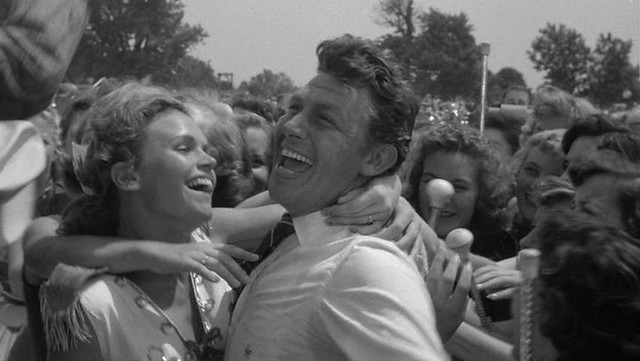
If it were a completely just world, A Face in the Crowd wouldn’t be a nearly forgotten film. It would be rightly recognized as one of the great socio-political satires of American cinema, ranking alongside masterpieces like Billy Wilder’s Ace in the Hole and Hal Ashby’s Being There. Those films both look as fresh today as they did when they were made, and the same is certainly true of Face, made in 1957 by direstor Elia Kazan and writer Budd Schulberg.

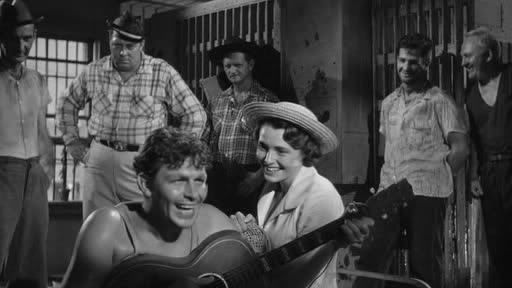
Marcia Jeffries (Patricia Neal) is working at a 2-bit Arkansas radio station when we first meet her. She hosts a man-on-the-street show called - You guessed it – “A Face in the Crowd”, and is just trolling for anything interesting when she happens across Larry Rhodes (Andy Griffith) in the local jail. Hung over and uncooperative at first, there’s a little glint in his eye when he hears the world “radio”….and sees Marcia. He sings a song about life as a hobo, and promptly launches a sensation.

Kazan was one of the great actor’s directors, meaning he could coax great performances out of his people, and AFitC is a glorious example of this. Take the decision to cast Andy Griffith as “Lonesone” Rhodes. He was not a star at that time – he was just a lesser known stand-up comic best known as a cast member of Steve Allens' show. Casting him in this role, which is so loud and over-the top was a huge risk, but in looking at the film, it’s perfect. Rhodes’ laugh is so aggressive that it takes his whole body to do it, but Griffith pulls it off.

Neals’ Marcia is also special. Patricia Neal was an actress who was not really a classic beauty, but who somehow managed to convey a smoky, grown-up sensuality. (For a great example, watch Hud sometime). Marcia is a small-time girl working in a small market, but you never doubt for a minute that she’s smart and capable of much, much more. That’s why she and Rhodes hit it off so well. She immediately sees him as the ticket to where she wants to go. When Rhodes uses his show to play a nasty practical joke on the sheriff who threw him in jail, she thinks it’s hilarious.
 
 
The character of Lonesome Rhodes is a homespun hillbilly populist, much in the vein of Will Rogers, and Rhodes uses the hick persona to his advantage. He knows what buttons to push. A notable early scene has him pull a black woman off the set and tell her story on the radio. He implores the audience to send 25 cents each to help her out, and they do. The legend grows.

The relationship between Lonesome and Marcia is complex, and is the spine that the whole film is built on. He loves her as the one person who really understands him. Although Lonesome is basically a clown and braggart, when he is with her, he becomes real, and we like him. She is amused by him, at first, but gradually grows more attracted to him, and by what she sees as his pithy, straight from the hip way. When the seduction comes, it is HER who initiates it, not him. She humanizes him, and her love of him absolves him in our eyes for the nagging distrust we feel about him.

There is one character, however who doesn’t quite buy into the growing legend of Lonesome Rhodes, and that is a writer named Mel Miller (Walter Matthau). Matthau plays Miller as one of those great cynical types who just kinda knows what is happening behind the smoke-screen, and he drops a line early on that is telling:

“You gotta be a saint to stand all the power that little box can give you”

 
Watching Matthau in this film makes you appreciate just how good he was, and what a shame it was that he so often got pigeonholed into Oscar Madison-like “basset hound” roles. Matthau was a smart actor when he got the chance, like as the Cold War hawk in Fail Safe, or his bank robber title character in Charlie Varrick. His Mel was one of those rare occasions that he got to break out and run with something different.

The film starts to take on darker overtones when Lonesome goes to judge a baton twirling contest and becomes enthralled with young Betty Lou Fleckum (Lee Remick). When you watch him devouring the nubile high school girl with his eyes, you start to get a sense of the soul-destroying corruption eating away at him. He runs off to Mexico and marries the teen, mere days after he has told Marcia that we wants to marry HER.


Lonesone is called upon to help facilitate the political career of a dull Congressman with designs on the White House (Marshal Neilan), and oversees him gettin’ a nickname and a hound dog. By now, Rhodes is thinking even larger than being a radio and TV star. He now sees himself as a political titan, able to become the real power behind a President, and is remorseless in dealing with anyone in his way.

The sequences that close the film are darkly ironic and pitch-perfect, as Lonesome is brought down by the person he would have least expected, and by the medium that made him a star. Griffith has a speech in his penthouse at the end that is so overwrought and extravagant that it inches right up to farce - And then jumps on over. That’s what Lonesome is, however – He’s a “Demagogue in Denim”, as Miller calls him, with the pedal to the metal at all times. As he replied early in the film when Marcia remarked that he put his whole self into his laugh:

“Marcia, I put my whole self into everything I do!”


Friday, January 18, 2013

My Week of Movie Watching


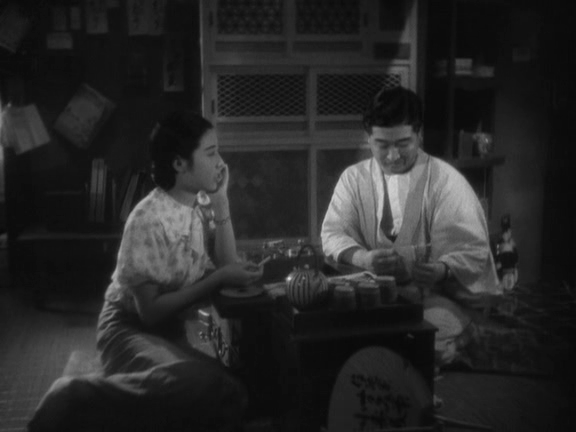
Sisters of the Gion    Outstanding 1936 film from Kenji Mizoguchi involves a pair of Geisha sisters – Sensitive, caring Umekicki and cold, calculating Omacha. Umekicki has had her now bankrupt patron move in with them. Omacha schemes to get the poor man out of the way. Problem is, Umekikci still loves him and feels indebted to him. Omacha also double-crosses a young man who is attracted to her in order to make a move on his wealthy boss. Mizoguchi’s films often concerned themselves with the way Japanese society locked women into rigid and harsh roles, and this one is one of his true masterpieces. Recommended.
 

This Gun For Hire – Spy noir from 1942 stars Alan Ladd as a hit man hired to kill a blackmailer, but gets stiffed by his bosses and goes after them. Veronica Lake is a nightclub singer hired by the feds to dig up info on the blackmailed men (who are selling secrets to the Japanese) Robert Preston stars as Lakes’ cop boyfriend. This one is a bit hard to follow in some spots, but it is enjoyable overall. Ladd’s killer is icy cold in the same manner as Alain Delon is in Le Samurai, and I wondered if the Ladd character influenced the Melville film in any way. (Where Delon’s Jef  had a pet bird, Ladd’s Raven has a kitten)

Paisan – The second film of Roberto Rosselini’s War trilogy consists of six chapters, each representing an area of Italy, and each concerning themselves with war-time interaction between Italians and Americans.  A group of GIs take an Italian girl along as a guide.  A black military police officer goes on a drunken adventure with a young boy.  A group of American clergy visit a monastery. All the stories are noteworthy, but best of all for me was a tale of an American soldier hooking up with an Italian prostitute that he doesn’t realize he has met before. The bit is only a few minutes long, but it is exquisitely sad and poignant. Very highly recommended.
 

Butterflies Are Free – This one surprised me. I was expecting a light little comedy, but got quite a bit more. Edward Albert plays a young blind man embarking out on his own for the first time. Goldie Hawn plays his free-spirited next door neighbour, and Eileen Heckart his domineering mother. Butterflies is adapted from a play, and feels a bit stage-bound at times, but the dialogue is first-rate, and I admired the way the film seems to set up stereotypical characters, then gradually pulls the rug out from under us. Recommended.
 

The Big Trees – Kirk Douglas as an arrogant timber baron who gets involved with a righteous woman with the intent of getting his hands on her family’s forest. That plot line is somewhat reminiscent of Elmer Gantry, without that story’s inherent sourness. This is not a bad film, but at the end I was asking myself if the two lovers could realistically stay together. I don’t think so.
 

Thursday, January 10, 2013

Sunday, January 06, 2013

My Week of Movie Watching


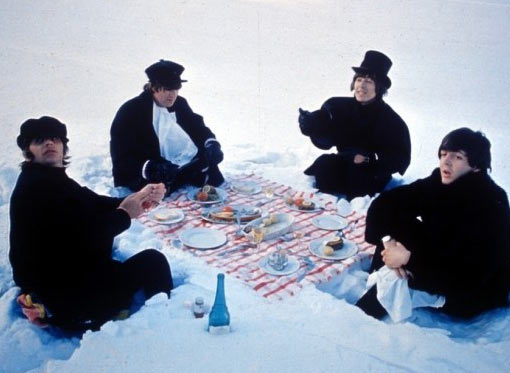
Help! – Unbelievable that I have gone this many years before seeing this for the first time. That being said, however, this ain’t  A Hard Days Night. Whereas that film was infused with the youthful exuberance of the Beatles, in Help! I can see a “Look at us…Aren’t we cute?!” attitude everywhere (especially from John Lennon). The plot involves a cult seeking a sacrificial ring that just happens to occupy the finger of Ringo. Much hilarity ensues as the cult chases the Fab Four over all corners of the earth.  I found the Beatles dialogue was overly cutesy and nonsensical this time, and that wore thin after a while. On the plus side, there is the music, which besides the title track, includes “I Should have Known Better”, “You’re Going to Lose That Girl”, and best of all, “You’ve Got to Hide Your Love Away” and “Ticket To Ride”. Nooooot quite recommended, however.

Pursued – Listen up, all of you who think Film Noir always is about urban crime and gangsters. This right here is a Noir western. Raoul Walsh made Pursued in 1947, and it’s a unique Western with Noir shadings all over the place. Robert Mitchum stars as a man who is taken in by a woman after his family is murdered, and who still has nightmares about whatever happened that night. Adding to the mix is the relationship he has with his adopted siblings. He is in love with his adopted sister (Teresa Wright), and the film doesn’t seem to think this is strange. There is also a rivalry with his “brother”, played by John Rodney.  There is also a shady businessman who is pretty up-front about the fact that he wants Mitchum dead.  Throughout, there is the sense that there are terrible secrets under the surface, and the films terrific climax lays everything on the table. Beautifully shot by James Wong Howe, who knew a thing of two about Film Noir. Recommended.
 

Tuesday, January 01, 2013

Cool


On Location

 
Robert Altman with Paul Newman on the set of Buffalo Bill and the Indians