Alec Guinness
An insufferable film snob wanders off the beaten track, then comes back and talks about what he has seen.
Sunday, December 08, 2013
Monday, November 18, 2013
My Week of Movie Watching
The Line-Up – Above-average police procedural from 1958 from
Don Siegel. Eli Wallach is a killer/smuggler trying to recover a cache of
heroin, and leaving a trail of bodies in his wake. A couple of veteran San
Francisco detectives (Marshall Reed and Emile Meyer) are hot on his tail. Like
most of Seigel’s work, this one is told without fluff or pretense – It’s just
good, straight-ahead storytelling. The film makes terrific use of the SF locale
with some great location shots, and culminates in a scintillating car chase on
an unfinished highway overpass. Recommended.
Moontide – Apart from a cool title, there’s not too much to
recommend about this 1942 Noir-ish entry from director Archie Mayo (who
replaced Fritz Lang at the helm). The great Jean Gabin made his Hollywood debut
as a party-loving drifter who may or may not have committed a murder during a
drunken binge. Ida Lupino plays a girl he rescues from a suicide attempt and
falls in love with. The film has an interesting premise, but unfortunately
doesn’t do much with it. The actual murderer is fairly obvious to anyone who
applies Roger Ebert’s Law of Economy of Characters, and after her life is
saved, the film forgets that Lupinos character was ever suicidal. Gabin is OK,
and the films’ climax on a windswept breakwater is nicely shot, but overall,
this one is a no.
Eva – Cool and cruel 1962 drama from the great Joseph Losey.
Stanley Baker plays a caddish writer who treats everyone he meets with distain,
all the while carrying a shattering secret. Jeanne Moreau plays a high end
prostitute who he becomes obsessed with. This one is interesting for the strange
chess game between the two leads. Bakers Tyvian is engaged to a beautiful, successful
woman who worships him, but is strangely drawn to the coldly sensual Eva, who
treats him with distain. There is an undercurrent of self-flagellation in
Tyvian's character, who is secretly a fraud. He seems to subject himself to Eva’s
abuses willingly, seemingly as some sort of penance. Not an easy film to warm
to, but worth the effort if you stick with it. Recommended.
Tuesday, October 29, 2013
Wednesday, October 02, 2013
Saturday, September 28, 2013
My Week of Movie Watching
Le Chinois
– Godards 1967 examination of a group of idealistic young Marxists. Godard is
usually a mixed bag for me. I admire the way he just goes ball-to-the-wall, and
how he is unafraid to bend the rules of narrative form until they scream. In
his best films, which for me are Week-end and Pierrot Le Fou, he is able to
marry his maverick story-telling to a more or less conventional plot, and it
works. Other times, his cleverness gets in the way, and that is the case too
often here. The first half of the film takes place primarily in an apartment
shared by the Marxists, and it is formless and pretty impenetrable, as the
characters spout socio-political mush at each other. There are some better
spots, primarily an extended dialogue aboard a moving train, but overall, this
is a miss for me.
Le Bandanas
– This 1935 offering from Julian Duvuvier was a nice surprise. Jean Gabin plays
a man who kills another man, and is forced to go on the lam. He joins the
Spanish Foreign Legion, but finds himself pursued by another soldier, who
happens to be an undercover cop. Gabin is terrific as a man who struggles with
personal demons. Recommended.
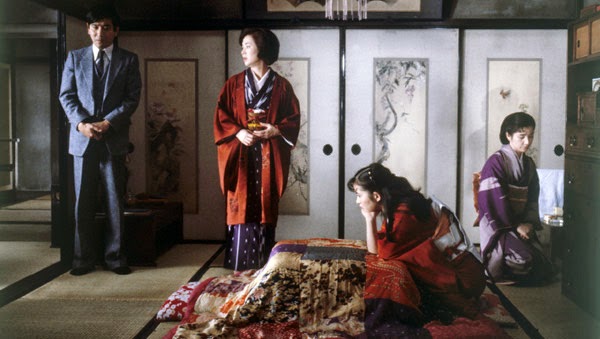
The Makioka Sisters – Kon Ichikawa is probably
my favorite of the great Japanese directors, and this 1983 offering is worlds
away from his best known offerings like Fires on the Plain or The Burmese Harp.
This centers on four sisters of a wealthy Osaka family, and the issues they
face as Japan teeters on the brink of societal changes just prior to WWII. Two
of the sisters are older and more traditional. The fourth one is a free spirit
who sees no need to confirm to the status quo. The third one is causing
headaches for the rest of the family because she is not interested in any of the
potential husbands the family is lining up for her. Sisters is brilliant in the
way that it uses this family as a microcosm of Japan – How the established,
older ways are now being challenged, and that the country is going through
something that will change it forever. The period sets and costumes are
stunning, and I highly recommend this.
Zero Focus – A brilliant little Japanese film
that I knew nothing about. A young bride has her new husband go off on a
business trip and disappear off the face of the earth. The film follows her quest
to find out what happened, and in the process she discovers that the husband
had a second, secret life. Focus is quietly relentless, and it slowly peels
back the layers of this story. Mush of the film is set against a wintry, harsh
mountainside, and this adds to the feeling of frustration and melancholy. The
conclusion, set on a windy precipice, is first rate. Recommended.
Vertigo – I try to never let too much time go
by without a Hitchcock, so I had to
check this one out again. This time around, I concentrated more on Kim Novaks’
Madelaine/Judy, and the tragic secret she is keeping from James Stewart. Novak
was not a great actress, but I found myself feeling a great empathy for this
character. This is such a complex role – Certainly the most complex female character
Hitch ever put on screen, and she does a pretty good job with it. There is one scene
that struck me this time. After Stewarts Johnny has forced her to make herself
over, they dance together, and it’s striking how cold and unaffectionate he is
with her. For Johnny, the idea of Madelaine is more powerful than the actual
woman.
Sunday, September 01, 2013
Thursday, August 29, 2013
Moments of Distinction
The Movie – Amadeus, dir. Milos Forman
The Set-Up – Mozart (Tom Hulce) lies dying, while the man responsible, Salieri (F.Murray Abraham) helps him finish his Requiem.
Amadeus is the story of one horribly conflicted man. Salieri loves music, and has given his life to it, but is shamed and angered by the loose cannon genius that is Mozart. So much so that he vows to destroy him. The rub is that Salieri loves Mozart’s music, and is really the only one who realizes that he is hearing something truly transcendent. All these emotions come together in this great sequence. Salieri hopes to be credited as a co-author on Mozarts last work, so his motives are dishonorable, but he is also exhilarated by being up close to Mozart creative process. Look how obediently he hands over the written pages when asked. My favorite part of this scene, however, is when Salieri has to ask Mozart to slow down. Even near death, the music is just flowing out of him. At one point Salieri puts his head in his hands because he can’t fathom what Mozart is trying to explain to him. It think it is right in this moment that Salieri really, really grasps that Mozart is a special being. This clip is unfortunately cut off before the end, but when Salieri finally tells Mozart, “You are the greatest composer I have known”, it’s the final straw. It isn’t hard to imagine that that moment is the one that really sends Salieri on his way to an asylum.
Monday, August 19, 2013
Saturday, August 03, 2013
Thursday, August 01, 2013
My Week of Movie Watching
Cat People and The Curse of the Cat People – First time
seeing these. Cat People was a real little treat – A bargain-basement horror
film that should be a primer on how to create fright on-screen. Director
Jacques Tourneur had virtually no money to work with, but by expertly
using light, shadow, and eerie sound effects, he managed to create a truly
frightening film. The story concerns a mysterious woman (Simone Simon) who
believes that she carries a curse that will turn her into a vicious panther if
she becomes aroused. This, predictably, causes problems when she marries a kind,
decent architect (Kent Smith). Things get even more deadly when she begins to suspect
that her husband is falling for one of his co-workers (Jane Randolph). Check out a scene where
the co-worker is terrorized in a swimming pool. Although you see literally
nothing, the scene builds an almost unbearable tension. Highly recommended.
Curse features the same cast playing the same characters, and is considered a
sequel, but is a very different movie. This one follows the young daughter of
the architect as she is approached by an imaginary “friend” (Simon again).
There is also a relationship with a strange old woman and her frightening
daughter (The daughter appears briefly in Cat People). This one is not
bad, but it falls far short of the original, because the movie never quite
manages to create any feeling of dread and unease. The film still has great
visual appeal, but the characters don’t engage. Thus, I can’t quite recommend it.
Saturday, July 27, 2013
Tuesday, July 16, 2013
My Week of Movie Watching
Criss Cross – Simply put, this 1949 gem from Robert Siodmak is one of the greatest of all Noirs. Burt Lancaster plays a man who returns to his home and rekindles an affair with his ex-wife (a stunning Yvonne DeCarlo). Things are complicated, however, by the fact she already has a man – nasty mobster Slim Dundee (Dan Duryea). The triangle leads Lancaster to agreeing to front a risky robbery in order to get himself out of an awkward spot. Lancaster is a little bit wooden in spots, but he is wonderful in the films closing minutes, as he realizes that he’s been played like a fiddle. Highly recommended. An added note: This was remade by Steven Soderbergh in 1995 as The Underneath, and it is worth a look, as well.
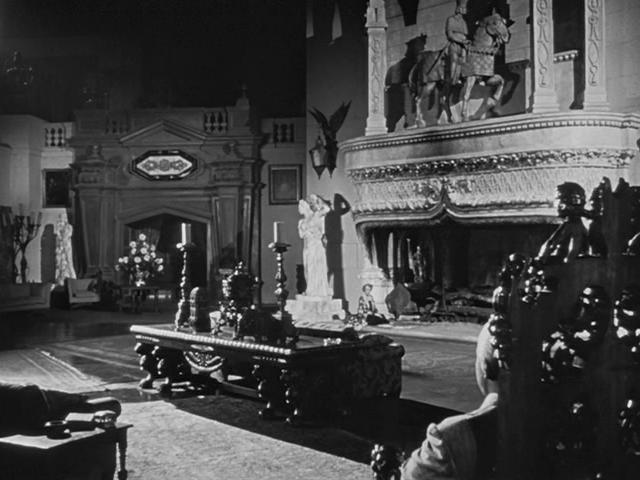
Citizen Kane – I hadn’t seen this in several years, so I thought it was time for another look. The thing that always strikes me about CK is how imaginative its story-telling is. The story is non-linear, but easy to follow partly because of the use of the newsreel at the beginning to “pre-tell” the story. There’s Welles’ use of the camera – high and low angle shots, his use of light and shadow, and depth of field are still stunning to look at today. One thing that doesn’t often get mentioned about Kane is the way sound is utilized to create effect – Consider the scenes in the vast Xanadu estate, where Kane and Susan are talking across a wide expanse, and the reverb of their voices amplify the emotional space between them. There is one strange plot point that I had forgotten about – Kanes son and first wife die in a car crash, and I find it a bit odd that the movie doesn’t do anything with that point – It’s mentioned, but then forgotten. Still, recommended – If you are a movie lover, you have to see Kane.
Monday, July 08, 2013
Thursday, July 04, 2013
My Week of Movie Watching
The Golden Coach – Sumptuous 1952 costume comedy from Jean
Renoir centers on a vivacious stage performer (Anna Magnani) who disrupts a
small Central American fiefdom. Magnani’s Camilla finds herself the object of
the affections of 3 suitors (including the local Viceroy), and when she
receives his ornate golden coach as a gift, all hell breaks loose. This is
superb from the standpoint of visual impact – The sets and costumes are first-rate,
but the story lagged a bit for me up until the end. A lukewarm recommendation.
Gentleman’s Agreement – Elia Kazan’s 1947 study of
anti-Semitism. Gregory Peck starts as a writer who goes undercover to experience
the everyday discrimination suffered by Jews. This one was kind of a mixed bag.
After a while, you just go on autopilot waiting for another bigot to pop up,
but I do have to admit that this film goes into a couple of places that I
wouldn’t have expected, like Peck’s icy blonde secretary. She’s a Jew who has
changed her name and masks a deep self-loathing. Dorothy McGuire plays Pecks
love interest, and she is interesting as well, due to her well-meaning
discrimination. John Garfield has a small yet vital role as Peck’s Jewish army
buddy, and the highlight of the film for me was an exchange between him and
McGuire towards the end where he lays out the danger of suffering in silence. A
recommendation, but with a few minor caveats.
Friday, June 28, 2013
Monday, June 17, 2013
Between the Covers
There has to be something mad and wonderful in store in any novel that begins with a guy getting bowled to death. That’s how William Kennedy kicks off Billy Phalens Greatest Game, and this study of Depession-era nightlife is a joy for anyone who loves to inhale sharp dialogue and great characters.
Kennedy’s evocation of 1938 Albany is of a city of cards and pool, fast women, and smoky, pissy-smelling bars. That’s Billy Phalens world, and it’s one he occupies comfortably. When the son of one of the members of Albany’s powerful McCall family gets kidnapped, however, the screws tighten up. Billy gets approached by the the McCalls as a potential mediator/snitch, and the novel follows him over the course of a couple of weeks while the drama plays out. Despite the seedy crowd he hangs with, Billy has a personal code – You pay your bets, you don’t cheat, and you don’t fink.
Hanging around the edges of the story is Billy’s father Francis, a onetime star baseball player who has dropped out of society due to a couple of tragic events in his past. Francis Phalen (The central character of Kennedy’s Ironweed) is only a peripheral character in Greatest Game, but his story, packed full of melancholy and numbing pain is a touchstone for many of Kennedy’s Albany novels.
It’s not an easy task to pick out an excerpt from a Kennedy novel, but I chose this rambling travelogue of Albany nightlife, written by a man who knows these streets well.
Now 1913 was gone, too, but Billy was gliding down Broadway in a craft of his own making, and he relished the sight. There was Albany’s river of bright white lights, the lights on in the famous Lunch, still en, and the dark, smoky reds of Brockley’s and Becker’s neon tubes, and the tubes also shaping the point over the door of the American hotel, and the window of Louis’s pool room lit up, where someone 3as still getting some action, and the light on in the Waldorf restaurant, where the pimps worked out of and where you could get a baked apple right now if you needed one, and the lights of the Cadillac cafeteria with the pretty great custard pie, and the lights on in the upper rooms of the Cadillac hotel, where the Greek card game was going on and where Broadway Frances was probably turning a customer upside down and inside out, pretty , tough, busy, knobby lady and Billy’s old friend, and the lights in the stairways to the Monte Carlo, where the action would go on until everybody ran out of money or steam, and the lights, too, in Chief Humphrey’s private detective office, the chief working late on somebody’s busted marriage, and the light in the back of red’s barbershop coming through a crack in the door, and Billy knew that red and others were in there playing blackjack. And look there, too, buddy boy: The lights are on in Bill’s Magic shop, where Bill is staying late, hoping to sell a deck of cards or a pair of dice or a punch board or a magic wand to some nighthawk in search or transport, and the lights are on, too, in Bradt’s drug store, where Billy does all his cundrum business.
Subscribe to:
Posts (Atom)